For European buyers sourcing aluminum pergola systems, CBAM is no longer only a reporting topic. The EU Carbon Border Adjustment Mechanism entered its definitive phase on 1 January 2026, creating new compliance and cost-planning considerations for imports of covered goods, including selected aluminium products.
However, CBAM does not mean that every aluminum pergola automatically carries the same carbon cost. The practical impact depends on the customs classification of the imported product, the importer’s annual CBAM volume, embedded-emissions data and the applicable CBAM certificate price.
This guide explains what EU buyers should review before placing an aluminum pergola order from outside the European Union.
What Is CBAM?
CBAM stands for the CBAM stands for the EU Carbon Border Adjustment Mechanism. It is the EU’s framework for applying a carbon-price adjustment to selected imported goods with embedded greenhouse-gas emissions.
Its purpose is to reduce carbon leakage: the risk that carbon-intensive manufacturing shifts outside the EU while imported goods compete with EU-produced goods that are subject to the EU Emissions Trading System. CBAM currently covers aluminium, iron and steel, cement, fertilisers, hydrogen and electricity.
For buyers, CBAM should be understood as an import-compliance and cost-planning issue, rather than a simple supplier surcharge.
Does CBAM Apply to Aluminum Pergolas?
The term “pergola” does not appear as a separate CBAM product category. CBAM applies according to customs classification codes.
The scope of CBAM is defined under Regulation (EU) 2023/956 and Annex I, which includes relevant aluminium goods and customs classifications. and parts of structures, including prepared aluminium plates, rods, profiles, tubes and similar products intended for use in structures. Many aluminum pergola structures, frame systems and structural components may require assessment under this category.
That does not mean every pergola shipment should automatically be declared under CN 7610. Product construction, level of assembly, accessories, material composition and customs treatment can affect classification.
Before confirming an EU project order, buyers should ask their customs broker or importer-of-record to confirm:
- The expected CN code for the complete product or shipment;
- Whether the shipment falls within CBAM-covered goods;
- Which entity will act as the authorised CBAM declarant;
- Whether the planned annual import volume is likely to exceed the CBAM threshold.
For buyers planning EU-bound projects, product configuration, structural weight, and available manufacturing documentation should be reviewed early with the aluminum pergola manufacturing facility
Who Is Responsible for CBAM Compliance?
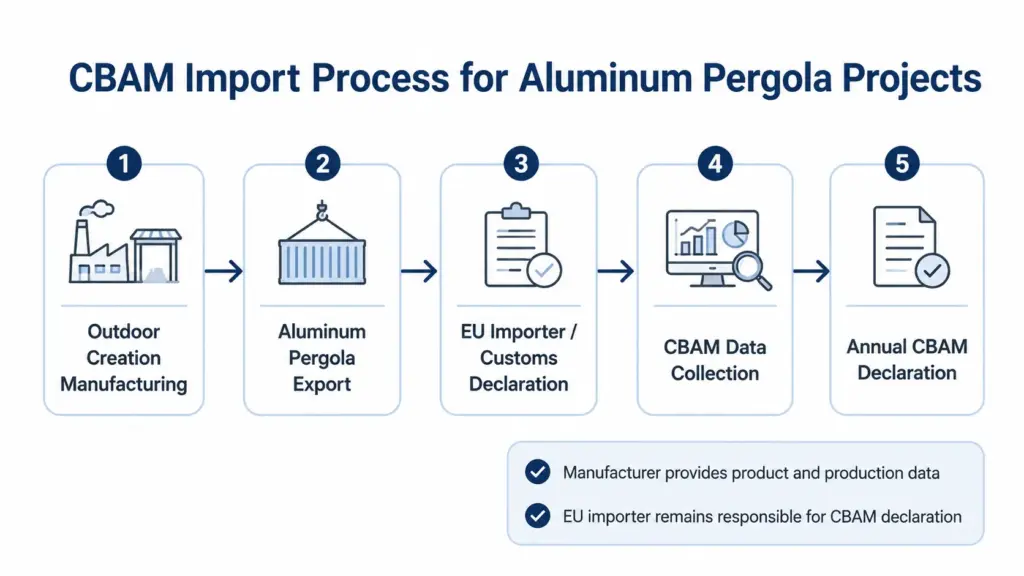
The legal CBAM obligation sits with the EU importer or, in some situations, its indirect customs representative. From 2026, importers of covered CBAM goods above the applicable threshold must hold authorised CBAM declarant status.
For a non-EU manufacturer, the role is different but still important.
The manufacturer or exporter may need to support the importer with product, production and emissions-related information. The importer remains responsible for the customs declaration, CBAM authorisation, annual declaration and surrender of CBAM certificates.
In practical terms:
| Party | Main CBAM Role |
|---|---|
| EU importer | Holds legal compliance responsibility |
| Customs broker / indirect representative | May act as authorised CBAM declarant |
| Manufacturer | Supports with product, material and production data |
| Buyer / procurement team | Plans cost exposure and requests documentation early |
Understanding the 50-Tonne CBAM Threshold
A key simplification introduced for CBAM is the 50-tonne annual threshold
For covered goods other than hydrogen and electricity, an importer remains exempt where the total net mass of CBAM goods imported during a calendar year does not cumulatively exceed 50 tonnes. The threshold applies across all relevant CBAM CN codes imported by that importer during the year, not only one product category or one shipment.
This means the threshold is not:
- 50 tonnes per container;
- 50 tonnes per purchase order;
- 50 tonnes per pergola series;
- 50 tonnes for aluminum pergolas only.
If an importer exceeds the threshold during the calendar year, CBAM obligations apply to all covered goods imported in that year, not only the volume above 50 tonnes.
For distributors, retailers and project buyers importing multiple CBAM-covered products, annual planning is therefore essential.
How Is CBAM Cost Determined?
CBAM is not calculated from the invoice value of a pergola. It is linked to the embedded emissions associated with the imported goods.
A practical planning sequence looks like this:
- Confirm the customs classification of the imported product.
- Determine the annual net import mass of covered CBAM goods.
- Identify the embedded emissions using applicable actual data or default values.
- Apply the legal adjustments for free EU ETS allocation and any eligible carbon price already paid in the country of origin.
- Calculate the number of CBAM certificates to be surrendered.
- Apply the relevant published CBAM certificate price
A useful planning expression is:
Indicative CBAM financial exposure = Net CBAM certificates required × Applicable CBAM certificate price
The final calculation can vary according to product classification, production route, declared emissions, accepted verification records and the specific legal rules applicable to the import period.
For 2026 imports, the European Commission calculates and publishes a separate CBAM certificate price for each quarter. The Q1 2026 price was published at €75.36 per tonne of CO₂e; later quarterly prices are published after the relevant quarter ends.
Important CBAM Dates for EU Pergola Buyers
| Timing | What It Means |
|---|---|
| 1 January 2026 | CBAM definitive period began |
| 2026 | Importers should track covered goods, quantities and embedded-emissions information |
| 1 February 2027 | CBAM certificate sales begin through the common central platform |
| 30 September 2027 | First annual CBAM declaration and certificate surrender deadline for 2026 imports |
EU importers above the threshold must submit their first annual declaration for 2026 imports by 30 September 2027 and surrender the corresponding CBAM certificates by the same deadline.
What Information Should Buyers Request From an Aluminum Pergola Supplier?
CBAM preparation should begin before production, not after the container has shipped.
For relevant projects, buyers should request a structured documentation package that may include:
- Product description and expected customs classification reference;
- Net product weight and material breakdown;
- Bill of materials for the main aluminium structure;
- Identification of the manufacturing installation;
- Information on key aluminium precursors and production route;
- Available embedded-emissions data;
- Method used to determine emissions;
- Supporting verification records where actual emissions are declared;
- Documentation relating to any carbon price effectively paid in the country of origin, where relevant.
Where actual emissions are used, CBAM recordkeeping requirements include information about the manufacturing installation, the emissions-calculation method and applicable verification reports.
Outdoor Creation can coordinate available product, material, and production information for relevant EU-bound outdoor aluminum pergola projects before order confirmation.
What CBAM Does Not Mean
CBAM should not be treated as a fixed percentage added to every aluminum pergola quotation.
It does not automatically mean a 4% or 5% price increase. The cost impact can differ substantially between importers and projects because it depends on net weight, CN classification, emissions data, import timing, certificate prices and the applicable legal adjustments.
It also does not mean that generic sustainability claims automatically reduce CBAM exposure. A factory’s renewable-energy use, recycling initiatives or environmental certifications may be relevant context, but they are not substitutes for the emissions data and verification requirements used in a CBAM calculation.
How Outdoor Creation Supports EU Project Buyers
For EU-bound aluminum pergola projects, Outdoor Creation can coordinate available product, material and production information at the quotation stage, helping buyers identify the documentation they may need for internal CBAM planning.
The final customs classification, importer authorisation and CBAM declaration remain the responsibility of the EU importer and its customs or legal advisers. However, confirming the information requirements before order confirmation can reduce avoidable delays later in the import process.
For project planning, buyers should provide:
- Destination country;
- Importer-of-record details;
- Expected annual volume;
- Product series and configuration;
- Estimated shipping schedule;
- Requested compliance-documentation scope.

Planning aluminum pergola imports for the EU?
Discuss your EU project requirements with Outdoor Creation before confirming the order.