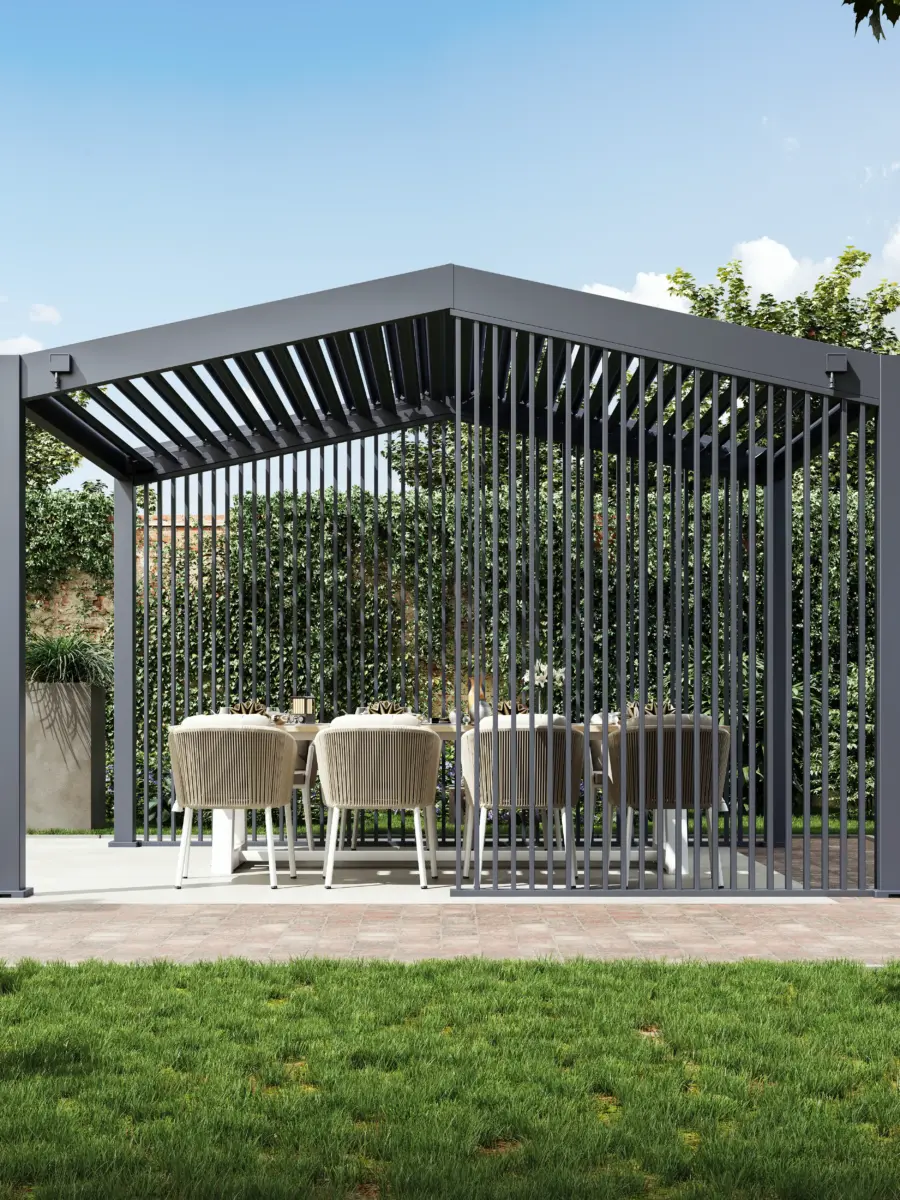
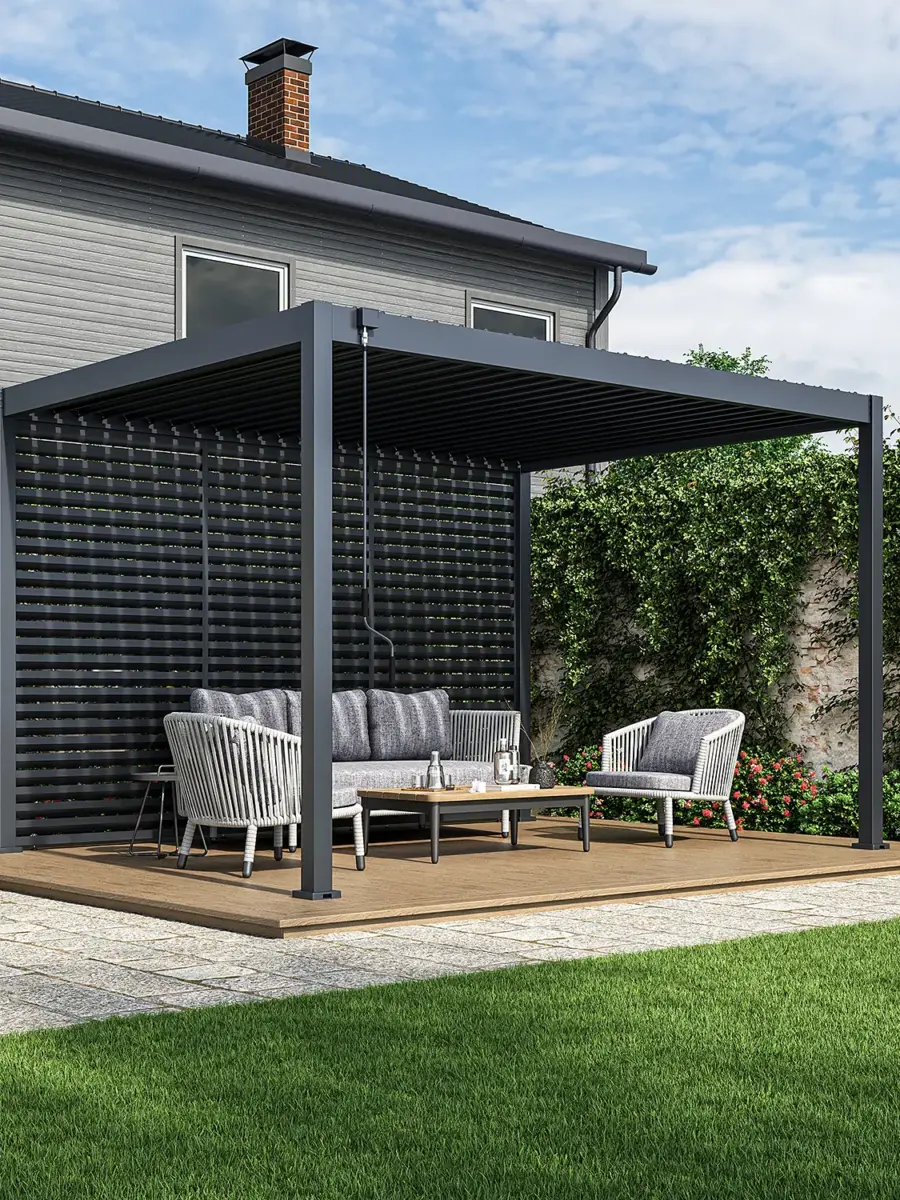
EN 13561 is a European product-performance and safety standard for external blinds and awnings fitted to buildings and other construction works. Its scope includes pergola awnings. For a louvered pergola buyer, the standard provides a structured way to assess specified characteristics such as wind resistance, operating safety, handling, installation information, maintenance instructions and product marking. It does not, by itself, prove that every size, configuration or installation is suitable for every site.
Direct answer: EN 13561 gives manufacturers, test laboratories and buyers a common framework for evaluating external blind and awning systems, including pergola awnings. A valid claim must still identify the exact product, tested configuration, report number, performance class, applicable clauses and installation limitations.
What Is EN 13561?
The full title is External blinds and awnings — Performance requirements including safety. The British Standards Institution describes BS EN 13561 as applying to external blinds and awnings intended to be fitted externally to buildings and other construction works, while also addressing significant hazards associated with assembly, transport, installation, operation and maintenance. Buyers can review the official standard overview from the
British Standards Institution.
The standard is broader than a wind-load test. It contains product characteristics, safety provisions, information requirements and marking rules. The exact clauses applicable to a specific pergola depend on the product design. A manual louvered roof, a motorized awning, a guided fabric system and a fixed component do not necessarily receive the same clause-by-clause assessment.
For this reason, an experienced louvered pergola manufacturer or supplier should not present “EN 13561” as an unexplained badge. The useful evidence is the complete test report showing which clauses were passed, which were not applicable, and which were not tested.
What Does the Standard Evaluate?
| Area | What It Addresses | What the Buyer Should Verify |
|---|---|---|
| Wind resistance | Resistance to defined nominal and safety pressures under the test method and product configuration. | Class, pressure values, tested dimensions, roof condition and report appendix. |
| Non-retractable parts | Performance of fixed elements that remain exposed when movable parts are retracted. | Whether the clause was tested, not applicable or not requested. |
| Operating and mechanical safety | Risks related to moving parts, controls, crushing, shearing, operating effort and foreseeable misuse. | Manual or motorized configuration and the clauses applicable to that operating system. |
| Handling and installation | Packaging, handling, fixing information and installation instructions. | Approved installation manual, anchor assumptions and site responsibilities. |
| Use, maintenance and marking | Operating instructions, warnings, maintenance information, manufacturer identity and product identification. | Current manual, product label, model number, year and electrical ratings where applicable. |
A report should therefore be read as a clause matrix, not only by looking at the word “Pass” on the cover. “N/A” normally means a requirement does not apply to the tested design. “N/T” means the item was not tested. These designations are materially different and should remain visible when a pergola company communicates technical evidence to distributors, contractors or project buyers.
How Wind Resistance Is Expressed
EN 13561 uses wind-resistance classes based on nominal wind pressure and safety wind pressure. The nominal pressure represents a level at which the product should not suffer deformation or deterioration that prevents correct operation. The safety pressure is higher and is intended to check that no dangerous deterioration occurs.
In the 2015 standard with the 2016 corrigendum, Class 6 corresponds to a nominal pressure of 400 N/m² and a safety pressure of 480 N/m². The safety pressure is calculated using a factor of 1.2. The test report then applies the relevant pressure over the defined product area to calculate the nominal and safety loads for the tested sample.
Important limitation:
The EN 13561 report itself states that the wind test is based on static loading and does not reproduce the repeated dynamic effects of turbulence in an actual installation. It also states that static pressure should not be used on its own to define anchoring to the building.
This distinction is critical. A wind class is product-performance evidence under defined test conditions. It is not a universal site-engineering approval. Building height, terrain, geographic wind zone, exposure, roof position, side enclosures, foundations and anchoring can all change the installed load path.
A Real Test-Report Example
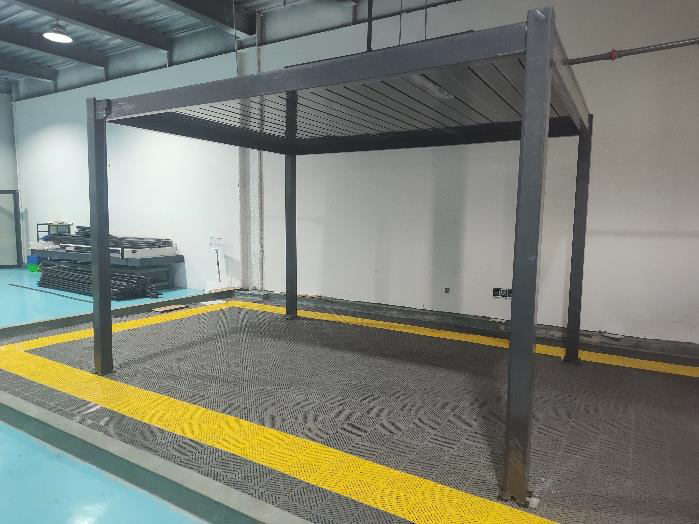
TÜV Rheinland report CN245FQZ 001R identifies an INTRO PLUS 3 × 4 m freestanding pergola as the sample used for complete mechanical testing within the listed model family. The report records a net weight of 140 kg, four ground plates and sixteen M10 × 80 mm concrete anchors for the tested arrangement.
The appendix records a Class 6 wind-resistance result. Using a tested width of 2.86 m and a loading dimension of 3.79 m, the nominal load was calculated at approximately 4,335.76 N and the safety load at approximately 5,202.91 N. After the safety load was applied, the measured displacement was 3 mm, below the report’s stated 11.44 mm criterion, and the sample remained functional with no reported damage.
The same appendix records Water Pocket Resistance Class 1 at a flow of 17 L/m²·h. This result should be described exactly as reported. It should not be converted into a broad claim that the pergola is “waterproof in all rain conditions,” because rainfall intensity, drainage maintenance, louver position, installation level and local weather remain relevant.
The report also identifies the operating element as a crank handle. That detail matters. A buyer evaluating a current motorized product should confirm whether the drive system, controls and associated electrical-safety clauses are included in the applicable technical file. Similar product names do not automatically establish identical test coverage.
EN 13561 Is Not the Same as CE Marking or Local Approval
| Document or Decision | Primary Function | Main Limitation |
|---|---|---|
| EN 13561 test report | Records assessment of a defined sample against specified clauses and test conditions. | Applies to the identified sample and justified product family, not every possible custom configuration. |
| Declaration of Performance and CE marking | Communicates declared performance under the applicable European regulatory route. | Must match the applicable product, standard, declared characteristics and manufacturer documentation. |
| Local permit or structural approval | Confirms compliance with the installation jurisdiction and project-specific requirements. | Cannot be replaced by a generic factory report or catalogue value. |
The European Commission explains that CE marking for a construction product indicates conformity with its declared performance and assessment through the relevant European route. Its
Declaration of Performance and CE marking guidance
should be read together with the applicable regulation and harmonised technical specification.
Outdoor Creation’s CPR-related report CN24AOIY 001 contains an important qualification: because EN 13561:2015+AC:2016 was not officially listed as a CPR harmonised standard for that report’s route at the time, relevant clauses from EN 13561:2004+A1:2008 were also considered, with a positive result. This is precisely why buyers should request the complete report and associated declaration rather than assuming that one standard number explains the entire regulatory basis.
EN 13561:2015 and its AC:2016 corrigendum are also listed in an
Official Journal decision concerning harmonised standards for machinery.
That listing concerns the relevant legal framework and should not be simplified into a claim that every pergola carrying an EN 13561 report is automatically approved under every European construction rule.
What EN 13561 Does Not Prove
- It does not prove suitability for every local wind, snow, seismic or foundation condition.
- It does not make one tested size automatically representative of every larger size or custom span.
- It does not confirm corrosion durability, coating life or coastal suitability unless those matters are separately specified and assessed.
- It does not make a louvered roof fully waterproof under every rainfall intensity or maintenance condition.
- It does not cover accessories, side screens, glass panels, heaters or custom modifications unless they are included in the evaluated configuration.
- It does not replace engineering review of the wall, slab, footing, anchors or surrounding building structure.
The scope section of the report expressly states that the structural part to which a pergola awning is fixed is not covered. For a wall-mounted pergola, the wall composition and load transfer must therefore be reviewed separately. For a freestanding pergola, the foundation and anchoring design remain project-specific.
What Buyers Should Request from a Pergola Manufacturer
- Exact report number: not only a certificate image or cropped first page.
- Model and configuration: freestanding or wall-mounted, manual or motorized, size and roof layout.
- Clause-level result: passed, not applicable and not tested items.
- Appendix data: pressure class, calculated loads, deflection, anchors and test arrangement.
- Current technical drawing: to confirm that the quoted product matches the tested design.
- Installation and maintenance instructions: including operating limits and inspection requirements.
- Regulatory documents: applicable declaration, marking information and destination-market requirements.
Buyers comparing an aluminum pergola factory, brand or supplier can also review the
louvered pergola manufacturer evaluation guide
and the
aluminum pergola quality-control checklist.
These resources separate third-party type testing from production inspection, drawing control and shipment-level quality evidence.
How Outdoor Creation Uses Test Evidence
Outdoor Creation develops and manufactures
aluminum louvered pergola systems
for distributors, contractors, outdoor living companies and project partners. The product range includes standard, upgraded and heavy-duty platforms such as
INTRO PLUS,
PRIME PLUS
and
PRIME MAX.
Third-party test reports form one part of the technical evidence package. Product drawings, approved specifications, manufacturing controls, installation documentation and destination-market review remain separate requirements. Buyers can review the
aluminum pergola manufacturing facility
and the
pergola FAQ center
for additional information about manufacturing, product selection, installation and project coordination.
The Practical Meaning of EN 13561
For a louvered pergola, EN 13561 is most useful as a disciplined evidence framework. It allows a buyer to move beyond general claims such as “wind resistant,” “CE certified” or “tested by TÜV” and examine the actual model, class, load, operating system, test conditions and exclusions.
A credible pergola manufacturer or supplier should explain both the result and its limits. The correct conclusion is not that one report makes every pergola suitable for every location. The correct conclusion is that a defined sample has been assessed against defined requirements, and that this evidence can support product selection when it is matched with current drawings, installation conditions, local engineering and applicable regulatory documentation.
Discuss Your Pergola Documentation Requirements
Share the target market, model, size, installation type, and documentation required for your project. Our team can coordinate available product specifications, test-report references and manufacturing information for technical review.
Technical note: Test reports apply to the samples, configurations and conditions identified in the documents. Product dimensions, operating systems, accessories, anchoring, foundations and local approval requirements must be confirmed for the actual order and installation site.