aluminum pergola is not simply a question of which metal is stronger
or which product costs less. The right decision depends on the complete project:
local climate, roof design, structural span, installation conditions, expected
maintenance, operating method, accessory requirements and the intended service life
of the pergola.
A basic steel pergola can be a practical solution for a standard residential patio
where controlled cost and simple manual operation are the main priorities. An
aluminum louvered pergola may be more appropriate for a coastal property, hospitality
terrace or project requiring motorized roof control, integrated drainage, lighting
and side enclosures.
There is also a third option that is often overlooked: a hybrid pergola combining
steel roof louvers with aluminum beams and posts. This configuration can provide a
middle position between an economical all-steel structure and a complete aluminum
pergola system.
This guide explains how steel, hybrid and aluminum pergolas differ, where each
material performs well, and which technical questions buyers should ask before
making a final selection.
Not Every Steel Pergola Has the Same Construction
Before comparing steel and aluminum, buyers should confirm which components are
actually made from each material. The term “steel pergola” is often used broadly,
even when only the roof louvers are made from steel.
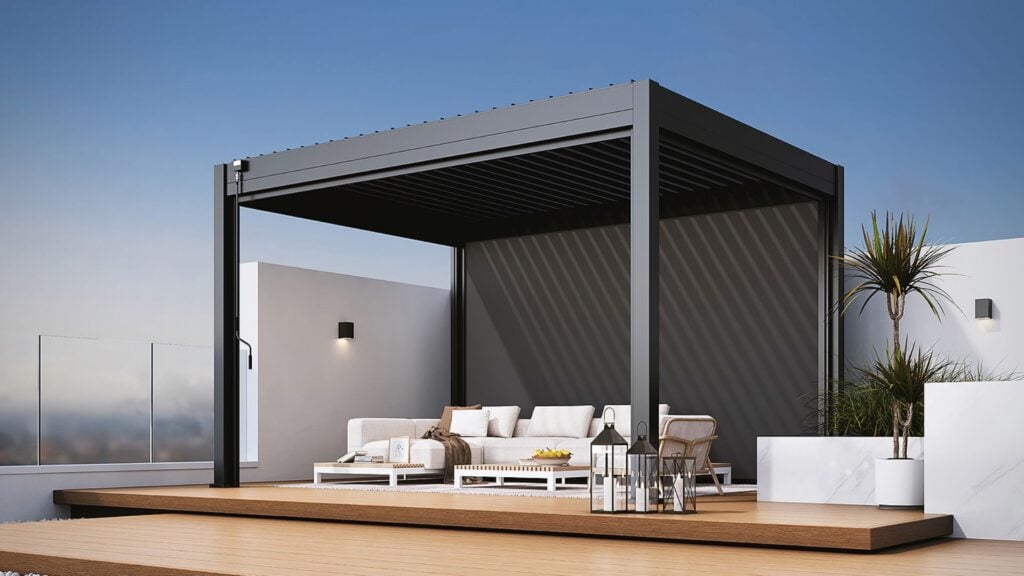
All-Steel Pergola
An all-steel pergola uses steel for the roof louvers, perimeter beams and supporting
posts. Outdoor Creation’s
ECOLINE manual steel louvered pergola
is designed as an economical freestanding solution using coordinated steel roof and
frame components.
This type of pergola is generally best suited to standard residential shade
applications where manual roof adjustment, standard dimensions and controlled
initial cost are more important than advanced motorization or enclosure options.
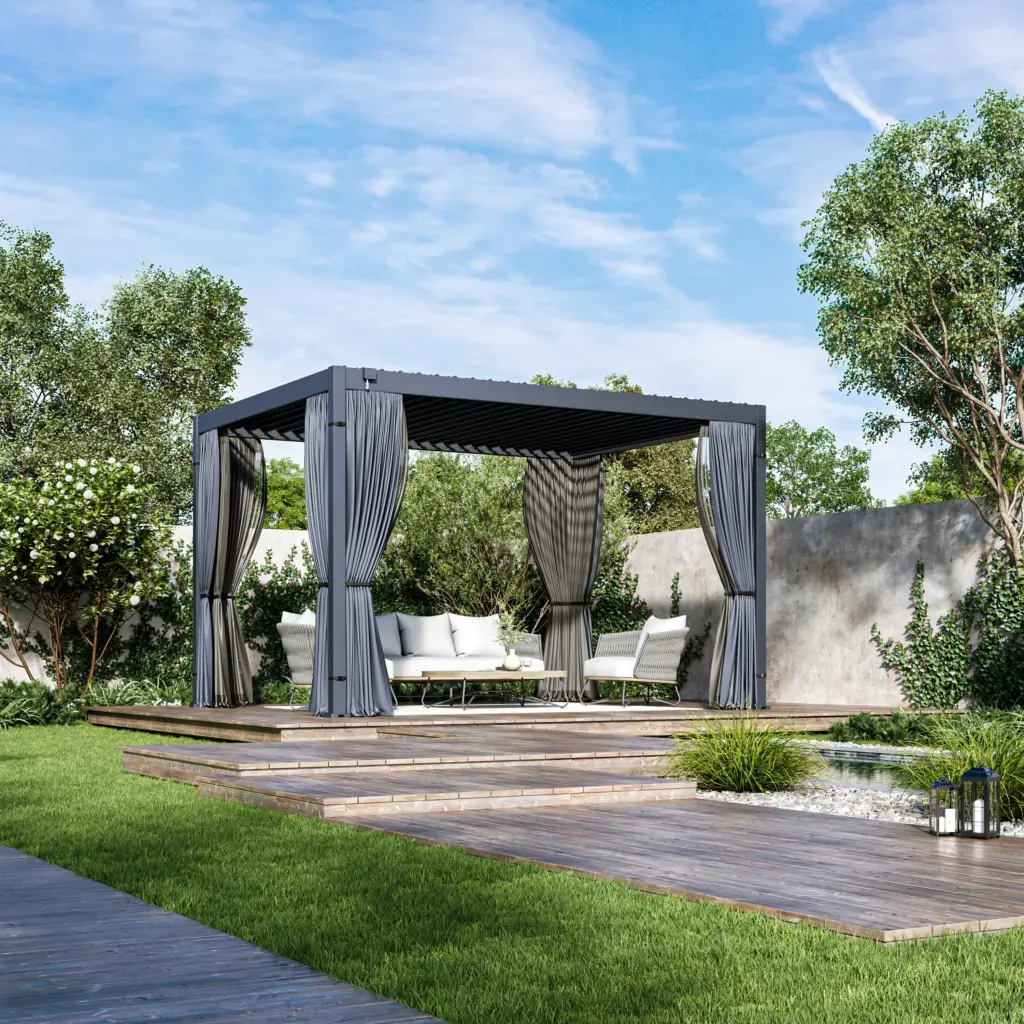
Hybrid Steel and Aluminum Pergola
A hybrid pergola uses different metals for different parts of the system. The
NEO STEEL manual louvered pergola
combines adjustable steel roof louvers with aluminum beams and posts.
This configuration retains the cost advantage of steel louvers while using aluminum
for the primary visible frame. It can therefore provide a practical transition
between a complete steel pergola and a full aluminum louvered pergola.
All-Aluminum Pergola
An all-aluminum pergola uses aluminum roof louvers, beams and posts. This category
includes straightforward manual systems, architectural roof forms, divided roof
systems and reinforced motorized pergolas.
Within the current Outdoor Creation product matrix, all-aluminum systems include
NEO ALU
,
APEX, INTRO DUO, INTRO PLUS, PRIME PLUS, PRIME MAX and PRESTIGE. These products cover
different combinations of manual or motorized operation, freestanding or wall-mounted
installation, structural profile sizes and accessory compatibility.
This distinction is important because comparing an all-steel manual pergola with a
reinforced motorized aluminum pergola is not a comparison of material alone. The roof
mechanism, drainage system, profile dimensions, span, load performance and accessory
integration may also be substantially different.
Steel Pergola vs Aluminum Pergola: Quick Comparison
| Selection Factor | Steel Pergola | Hybrid Steel and Aluminum Pergola | Aluminum Pergola |
|---|---|---|---|
| Typical positioning | Economical, standard-size and manually operated projects | Cost-conscious projects requiring an aluminum frame with steel roof louvers | Residential, architectural, hospitality and motorized pergola projects |
| Initial product cost | Usually lower for comparable entry-level configurations | Typically positioned between all-steel and all-aluminum systems | Usually higher, especially with reinforced profiles or motorization |
| Corrosion management | Depends heavily on surface preparation, coating quality and maintenance | Steel louvers require coating inspection; mixed-metal connections must be properly detailed |
Does not develop red rust like carbon steel, but coating, drainage and compatible fasteners remain important |
| Weight and handling | Generally heavier for a comparable component volume | Reduced frame weight compared with an all-steel structure | Lower material weight can simplify transport, lifting and assembly |
| Design integration | Well suited to straightforward manual structures | Supports a clean aluminum frame with an economical adjustable roof | Well suited to concealed drainage, wiring, lighting, screens and motorized controls |
| Maintenance priority | Regular inspection of coating damage, edges, joints and fasteners | Inspection of both steel roof surfaces and mixed-material connections | Routine cleaning, drainage inspection and checking of coating and fasteners |
| Best-fit environment | Controlled inland and residential applications with suitable coating care | Value-focused residential projects requiring balanced material selection | Humid, coastal, premium residential and commercial projects where life-cycle maintenance matters |
Structural Performance Depends on the Complete Pergola System
Steel is frequently selected when high stiffness must be achieved within a compact
section. Aluminum is substantially lighter and offers a high strength-to-weight
ratio, but aluminum pergolas normally use engineered hollow profiles, internal
reinforcement and carefully designed connections to achieve the required finished
system performance.
Material name alone does not determine the load capacity or wind performance of a
pergola. A finished system must be evaluated according to the following factors:
- Louver profile dimensions and wall construction
- Beam and post dimensions
- Maximum pivot and span
- Number and position of posts
- Corner and beam connections
- Anchoring and foundation design
- Roof drainage configuration
- Local wind, rain and snow conditions
Outdoor Creation’s product matrix illustrates this clearly. Entry-level manual
pergolas use more compact profile combinations, while reinforced aluminum models use
larger beams, posts and roof structures to support greater spans and higher loading
requirements.
A heavier steel pergola should not automatically be assumed to perform better in
wind. Wind resistance depends on the complete geometry of the structure, roof
position, exposed surface area, structural connections, anchoring system and
foundation conditions. Product weight cannot replace a site-specific structural
assessment.
The correct procurement question is therefore not simply:
“Is steel stronger than aluminum?”
The more useful question is:
“Does this specific pergola configuration provide the span, loading performance,
post layout and anchoring design required for the installation site?”
Corrosion Resistance and Climate Exposure
Corrosion is one of the most important practical differences between a steel pergola
and an aluminum pergola.
Corrosion Considerations for Steel Pergolas
Carbon steel can rust when moisture and oxygen reach the underlying metal. Protective
systems such as galvanizing, primers, paint and powder coating reduce this exposure,
but their effectiveness depends on surface preparation, coating thickness, fabrication
quality, installation damage and the surrounding environment.
This does not mean a powder-coated steel pergola is unsuitable for outdoor use. It
means that the protective finish is a functional part of the system rather than a
purely decorative surface.
Areas requiring particular attention include:
- Cut edges and drilled holes
- Welded areas
- Fastener locations
- Louver ends
- Corners where water can remain
- Scratches caused during transport or assembly
- Areas exposed to irrigation water, pool chemicals or salt deposits
Corrosion Considerations for Aluminum Pergolas
Aluminum does not develop the same red rust as carbon steel. Its surface naturally
forms a thin oxide layer, while powder coating provides an additional environmental
barrier and the required architectural finish.
Aluminum is therefore commonly selected where reduced corrosion maintenance and lower
structural weight are important. It is particularly relevant for coastal areas,
poolside spaces, humid climates and hospitality projects where frequent maintenance
disruption is undesirable.
Aluminum is not completely immune to corrosion. Salt deposits, trapped moisture,
damaged finishes, unsuitable fasteners and direct contact between dissimilar metals
can still create pitting, crevice corrosion or galvanic corrosion.
Coastal installations should therefore use compatible connectors and fasteners,
correctly detailed drainage paths and a suitable cleaning schedule. Periodic
fresh-water rinsing is especially important where airborne salt or pool chemicals can
accumulate on the structure.
For buyers comparing a standard steel model with a
manual aluminum louvered pergola
,
climate exposure should be evaluated together with purchase price and maintenance
expectations.

Maintenance and Total Life-Cycle Cost
Steel pergolas often have an advantage in initial purchase cost, particularly in
standardized manual configurations. This can make an all-steel pergola appropriate
for retail programs, cost-conscious residential projects and outdoor spaces where
advanced electrical or enclosure systems are unnecessary.
The purchase price, however, is only one part of the total project cost.
Steel Pergola Maintenance
Maintenance planning for a steel pergola should include regular inspection of
scratches, chipped coatings, exposed edges, fasteners and water-retaining joints.
Small damaged areas should be cleaned and repaired before corrosion spreads beneath
the surrounding coating.
In aggressive environments, the inspection and repair interval may need to be
shorter. Buyers should also confirm whether touch-up paint, replacement louvers and
other service components are available from the supplier.
Aluminum Pergola Maintenance
An aluminum pergola still requires maintenance, but the routine is generally focused
more on cleaning and drainage than on rust control.
Typical aluminum pergola maintenance includes:
- Removing leaves and debris from gutters
- Keeping drainage outlets open
- Rinsing salt, dust and pollution from coated surfaces
- Inspecting fasteners and connectors
- Checking seals and moving roof components
- Inspecting motors, controls and electrical accessories where fitted
Calculate Cost Over the Expected Service Period
A complete life-cycle comparison may include:
- Initial product price
- Protective treatment and coating specification
- Packaging and international freight
- Installation labor and lifting requirements
- Periodic cleaning
- Coating repair
- Replacement of damaged components
- Access required for future maintenance
- Expected project service period
For a compact inland residential patio, the lower initial cost of steel may remain
the most important factor. For a hotel terrace, restaurant seating area or coastal
villa intended for long-term use, reduced maintenance disruption may justify the
higher initial investment in aluminum.
A professional material comparison should therefore evaluate
cost per year of expected use, not only the initial cost per pergola.
Transport, Assembly and Anchoring
Aluminum weighs less than steel for a comparable material volume. This can reduce
component handling requirements, simplify lifting and improve installation
efficiency. The final shipping difference, however, depends on profile dimensions,
wall thickness, packaging density and the total number of structural components.
Steel components may require more lifting effort, but the material can support
economical standardized production and straightforward manual pergola designs.
Neither material should be installed without a suitable foundation and anchoring
system. A pergola must transfer wind and structural forces into an appropriate
concrete slab, footing or engineered base.
Before installation, the project team should confirm:
- Substrate and concrete condition
- Anchor type and embedment depth
- Minimum edge distance
- Base-plate position
- Drainage route
- Local wind requirements
- Wall structure for wall-mounted installations
A lightweight aluminum pergola is not automatically safe because it is easier to
assemble, and a heavy steel pergola is not automatically safe because it has more
mass. Correct anchoring is essential for both materials.
Roof Operation and Accessories May Matter More Than Material
Some buyers begin with a material preference but later discover that roof operation
and accessory requirements determine the final selection.
The steel range is primarily focused on practical manual adjustable louver systems.
ECOLINE provides an all-steel freestanding configuration, while NEO STEEL combines
steel louvers with aluminum beams and posts.
The aluminum range extends further across manual, motorized, divided-roof,
wall-mounted and reinforced project configurations. NEO ALU provides manual roof
adjustment in an all-aluminum structure, while INTRO PLUS, PRIME PLUS, PRIME MAX and
PRESTIGE support progressively more advanced project requirements.
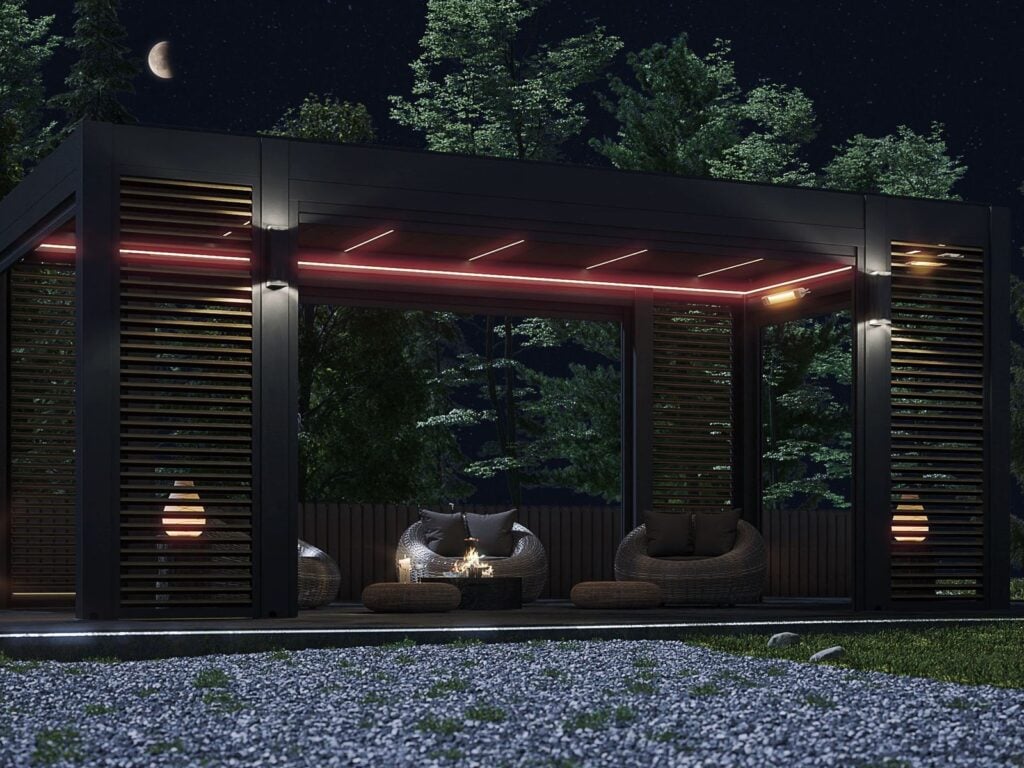
For example, the
INTRO PLUS motorized aluminum louvered pergola
supports automated roof operation and is better aligned with projects where
convenience, electrical control and integrated outdoor living functions are required.
Aluminum extrusion also supports the integration of shaped drainage channels,
concealed wiring routes, beam lighting, louver lighting, motors, wind screens,
decorative side panels and sliding or frameless glass systems.
Buyers planning privacy screens, motorized side protection, integrated lighting,
heaters or partial enclosure should confirm compatibility before selecting the base
pergola. Retrofitting unsupported accessories later can be more difficult and
expensive than specifying them during the initial design stage.
Explore available
pergola accessories and add-ons
when evaluating the complete outdoor structure rather than the roof frame alone.
When a Steel Pergola Is the Better Choice
A steel pergola may be the more rational option when:
- The project has a controlled initial budget.
- Standard freestanding sizes are suitable.
- Manual louver operation is preferred.
- Electrical preparation is unnecessary.
- The installation is in a relatively moderate inland environment.
- The owner accepts periodic coating inspection and maintenance.
- The pergola is intended mainly for residential shade.
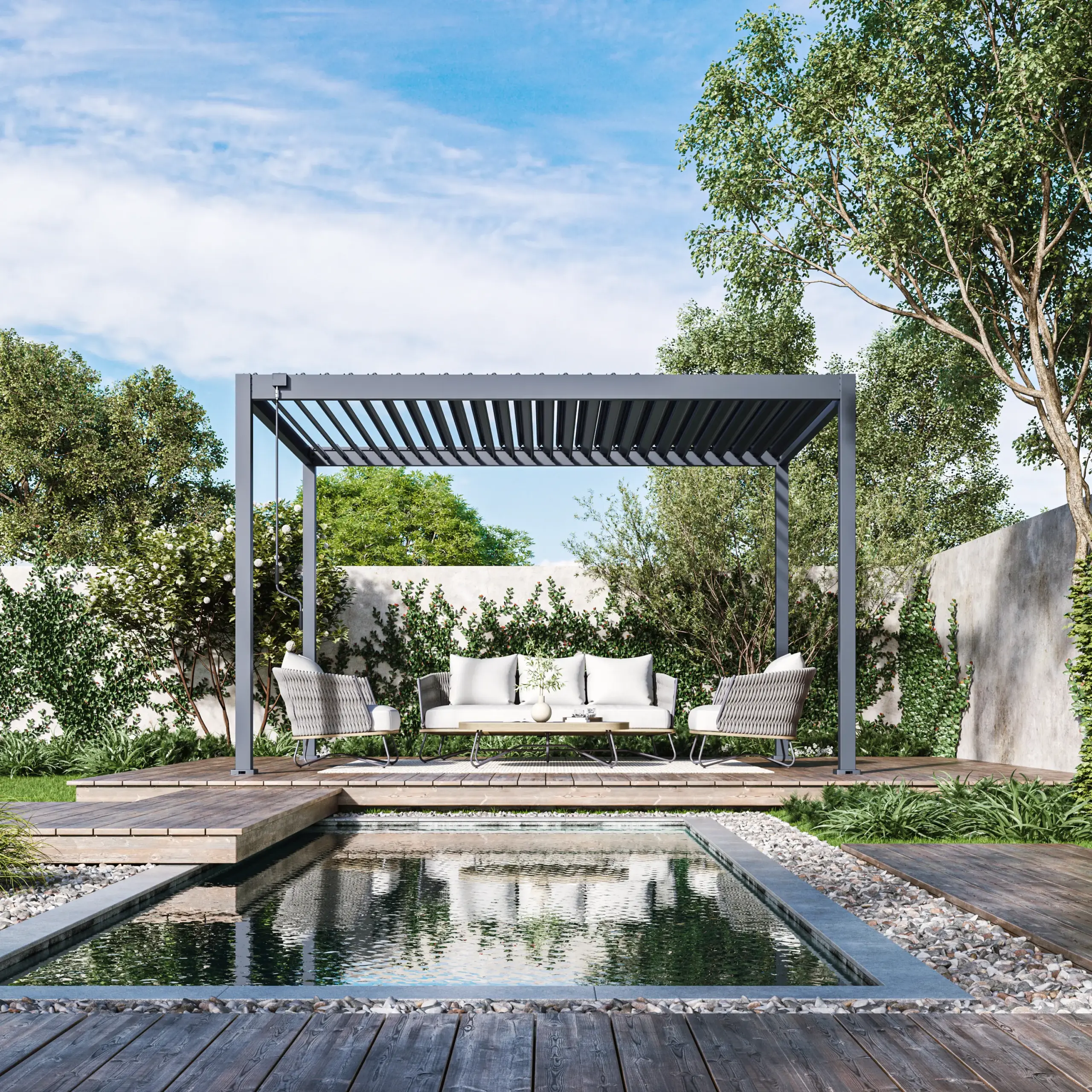
ECOLINE is the clearest example within the current range. It is positioned as an
economical manual steel louvered pergola for practical patio and garden use, where
controlled cost and functional shade are more important than motorization or premium
enclosure systems.
View the
economical all-steel manual louvered pergola
for a representative entry-level steel configuration.
When a Hybrid Pergola Makes Sense
A hybrid pergola is appropriate when buyers want to retain steel roof louvers while
upgrading the visible frame to aluminum.
NEO STEEL combines steel louvers with aluminum beams and posts. It remains a manually
operated, cost-focused pergola but provides a different material balance from an
all-steel system.
This configuration may suit projects where:
- The steel roof helps maintain a controlled product cost.
- An aluminum frame is preferred for appearance or maintenance.
- Manual adjustment is sufficient.
- The project does not require a premium motorized roof.
- Buyers want a transition between entry-level steel and full aluminum models.
The steel louvers still require suitable coating protection and periodic inspection.
Connections between different metals should also be designed and assembled using
compatible components to reduce galvanic interaction.
Review the
hybrid steel and aluminum louvered pergola
when the project requires a balanced approach to cost, appearance and maintenance.
When an Aluminum Pergola Is the Better Choice
An aluminum pergola is generally the stronger long-term candidate when the project requires:
- Reduced corrosion maintenance
- Coastal or humid-environment suitability
- Motorized roof control
- Integrated drainage and electrical routing
- Wall-mounted or project-specific configurations
- Lighting, wind screens, glass walls or privacy panels
- Larger spans or reinforced profile systems
- A premium architectural appearance
- Long-term residential, hospitality or commercial use
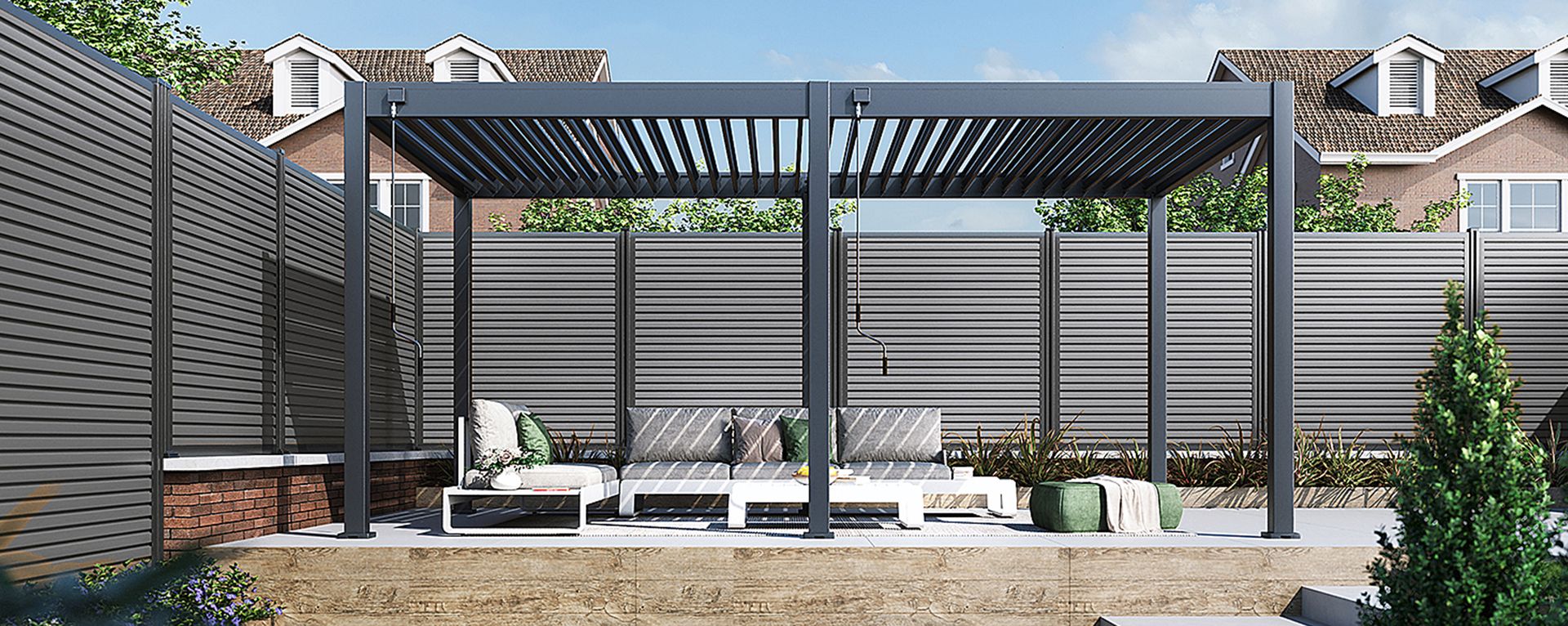
For a straightforward manual residential project, NEO ALU provides an all-aluminum
alternative to NEO STEEL. For projects requiring motorization, heavier profiles or
greater accessory integration, INTRO PLUS, PRIME PLUS, PRIME MAX and PRESTIGE provide
more specialized configurations.
The important point is that “aluminum pergola” describes a material family rather
than one performance level. Profile size, roof construction, span, motorization,
mounting type and accessory compatibility still need to be matched to the actual
project.
Browse the complete
aluminum pergola and louvered roof system range
to compare manual, motorized, freestanding and wall-mounted configurations.
A Practical Pergola Material Selection Checklist
Before approving a steel or aluminum pergola, the buyer should request clear answers
to the following questions:
- Which components are steel and which components are aluminum?
- What aluminum alloy, steel grade and surface-treatment process are used?
- What are the louver, beam and post dimensions?
- What are the specified maximum pivot, span and loading capacity?
- Is the system freestanding, wall-mounted or available in both layouts?
- How are rainwater and condensation discharged?
- Which fasteners and connectors are used in exposed or coastal environments?
- What maintenance is required if the powder coating is scratched?
- Which screens, lights, heaters, doors and control systems are compatible?
- What anchoring and foundation conditions are required at the site?
- Are replacement louvers, motors and other service parts available?
- Has the selected configuration been evaluated for the project’s local conditions?
A responsible pergola supplier should not recommend a product based only on appearance
or material name. Product selection should begin with the site, climate, dimensions,
operating method, accessory plan and expected service conditions.
Final Decision: Steel Pergola or Aluminum Pergola?
There is no universal winner in the steel pergola vs aluminum pergola comparison.
A well-coated steel pergola can be a practical and economical choice for standard
residential shade applications. A hybrid pergola can combine steel roof louvers with
an aluminum frame to balance cost, appearance and maintenance. An aluminum pergola is
usually better suited to projects requiring lower corrosion maintenance, advanced
roof control, integrated accessories and a longer-term architectural solution.
The material should never be evaluated separately from the complete pergola system.
Compare profile dimensions, roof mechanism, drainage, coating specification,
structural data, anchoring requirements and accessory compatibility.
Once these factors are clear, the choice between steel and aluminum becomes a useful
engineering and procurement decision rather than a simple marketing claim.
Discuss Your Pergola Material and Project Requirements
Material selection should be coordinated with the required size, mounting method,
roof operation, local climate and accessory plan. Share your project dimensions,
application environment and performance requirements with the Outdoor Creation team
before confirming the final pergola configuration.
Discuss your pergola material, size and project requirements.