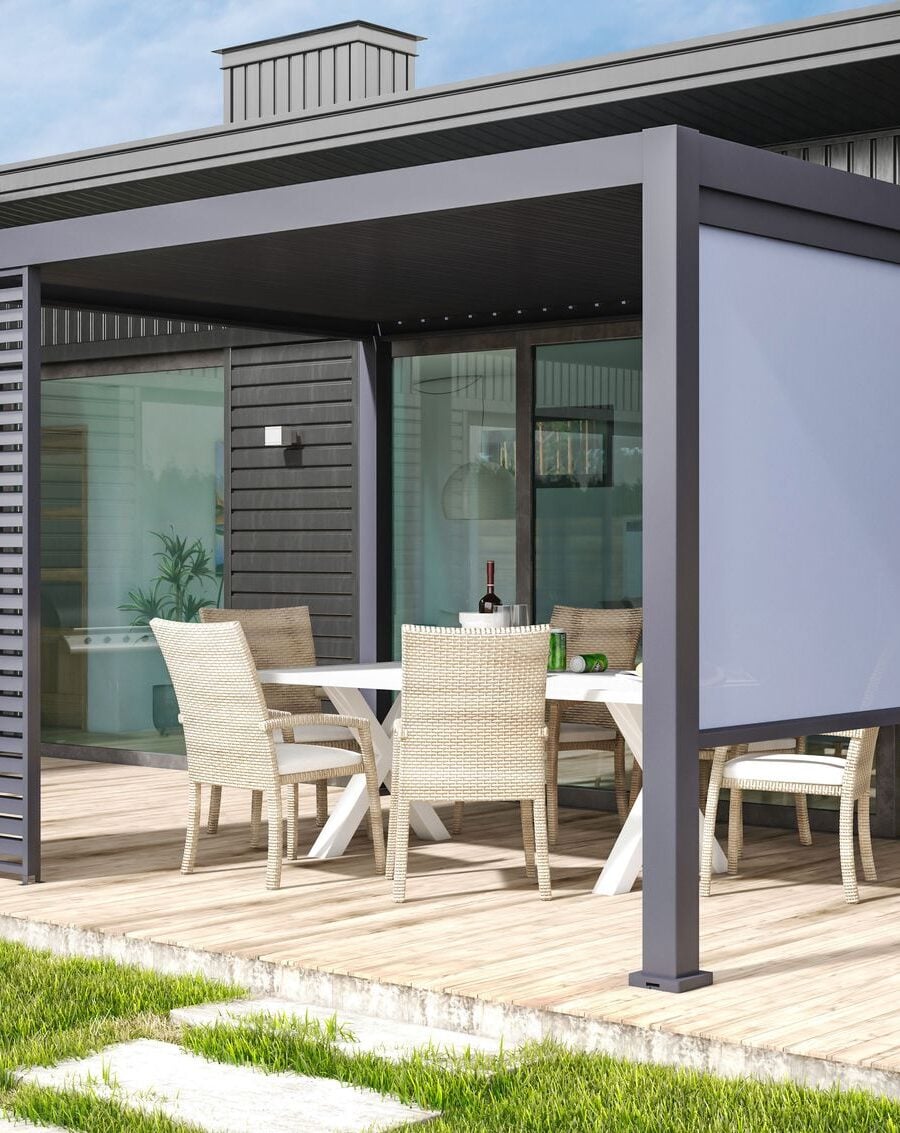
A metal pergola can refer to several different outdoor shade structures: an open metal frame, a pergola with a fixed metal roof, a canopy-covered structure, or an adjustable metal louvered pergola. A steel pergola is one category within this broader group, but not every product marketed as a steel pergola uses steel for the roof, beams, and posts. Buyers and users should confirm the complete material configuration, roof type, coating system, dimensions, operation method, and installation requirements before comparing products.
Direct answer: A metal pergola is an outdoor shade structure made primarily from metal components. A steel pergola is a type of metal pergola, while other systems may use aluminum or combine steel roof louvers with aluminum beams and posts.
For international buyers seeking an adjustable roof, the most relevant option is usually a metal louvered pergola. Its rotating louvers provide controllable shade and ventilation, while a fixed metal roof or fabric canopy operates differently and should not be treated as the same product category.
What Is a Metal Pergola?
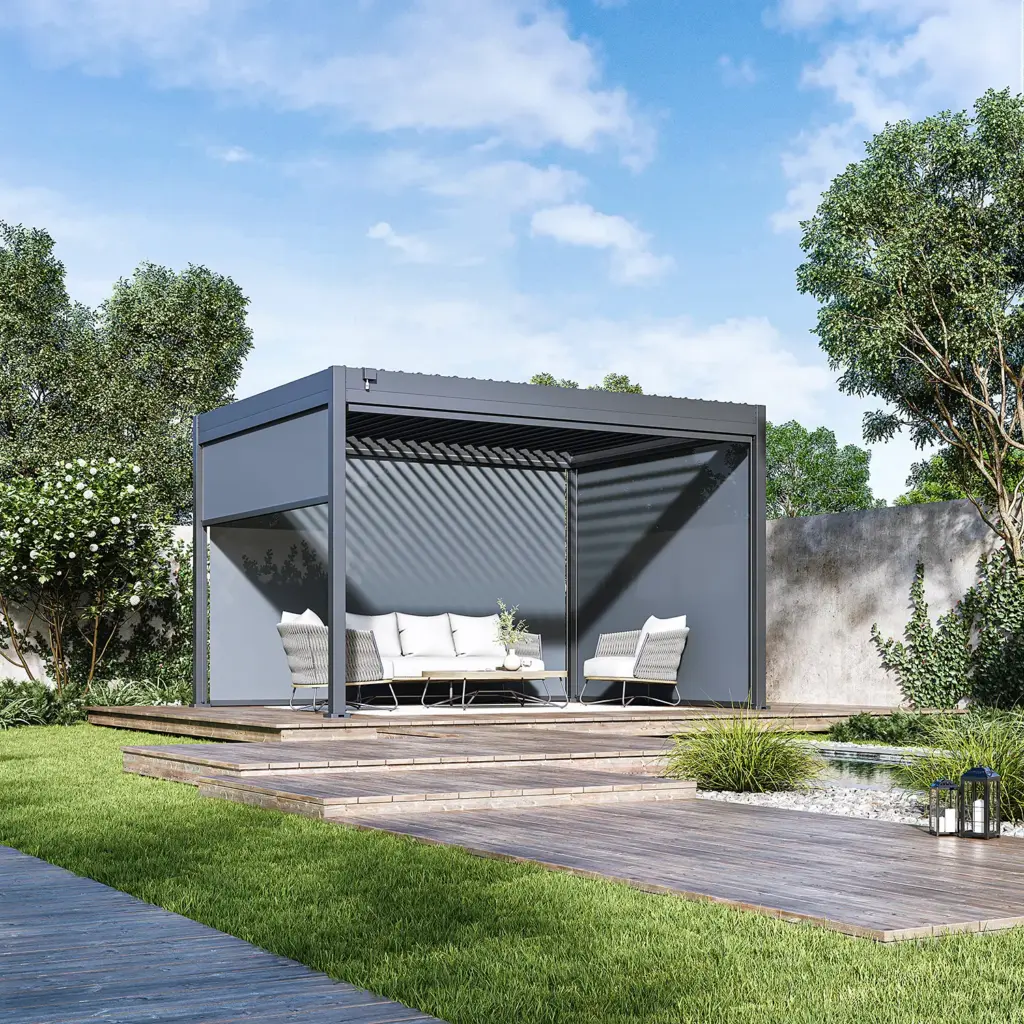
A metal pergola is an outdoor structure in which the main frame, roof components, or both are made from metal. The term is broad and may describe products using carbon steel, galvanized steel, stainless steel, aluminum, or a combination of different metals.
Searches for terms such as metal pergola, metal frame pergola, outdoor metal pergola, y modern metal pergola often refer to visually similar structures with very different technical configurations. One product may be an open decorative frame, while another may include a fixed corrugated roof, a retractable fabric canopy or adjustable louvers.
For this reason, buyers should not evaluate a product only by the phrase “metal pergola.” The useful questions are:
- Which components are made from steel?
- Which components are made from aluminum?
- Is the roof open, fixed, retractable, or adjustable?
- Is the system manual or motorized?
- Is the structure freestanding or attached to a building?
- What surface treatment protects the exposed metal?
- Which size, loading and installation conditions apply?
Outdoor Creation’s steel pergola systems focus on practical manual louvered roofs for patios, gardens, backyards and other outdoor shade applications.
Is a Metal Pergola the Same as a Steel Pergola?
Not exactly. “Metal pergola” is the wider category, while “steel pergola” describes a product that uses steel in at least part of its main construction.
Some steel pergolas use steel louvers, steel beams and steel posts. Others use steel only for the roof louvers and combine them with an aluminum frame. Both may appear under general metal pergola or steel pergola searches, but their weight, maintenance priorities, appearance and production cost can differ.
All-Steel Pergola
Steel is used for the pergola roof louvers, surrounding beams and structural posts.
This configuration is commonly selected for standardized, cost-conscious and manually operated outdoor shade applications.
Hybrid Metal Pergola
Different metals are used for different functions, such as steel roof louvers with aluminum beams and posts.
This configuration provides a middle position between a complete steel frame and a full aluminum pergola system.
Material terminology should match the actual product
An all-steel pergola and a pergola with steel louvers are not identical. Product pages, quotations, drawings and inspection documents should identify the material used for the louvers, beams, posts, brackets and other relevant components.
What Types of Metal Pergola Roofs Are Available?
The phrase metal pergola with roof can describe several roof systems. Their weather performance, operation, and maintenance are not interchangeable.
| Roof type | How it works | Main consideration |
|---|---|---|
| Open metal frame | Provides architectural definition and partial shade but does not form a closed roof. | Often used for climbing plants, decorative slats or open garden structures. |
| Fixed metal roof | Uses permanent sheet-metal, insulated or corrugated roof panels. | Provides continuous cover but does not offer adjustable daylight or airflow. |
| Retractable canopy | Uses fabric or another flexible cover that moves across a metal frame. | Fabric performance, tension, wind limits and replacement requirements must be reviewed. |
| Adjustable louvered roof | Rotating louvers change angle to regulate shade, light and natural airflow. | The buyer must confirm louver material, operation method, closing position and drainage design. |
Outdoor Creation’s current steel pergola range is positioned within the adjustable louvered roof category. It is not a fixed corrugated metal roof or retractable fabric canopy system.
A manual metal louvered pergola is suitable where users want adjustable shade without motors, electrical wiring or control systems. The louvers can be repositioned according to sunlight and ventilation needs, while the simpler operating method can reduce electrical preparation and component complexity.
What Are the Advantages of a Steel Pergola?
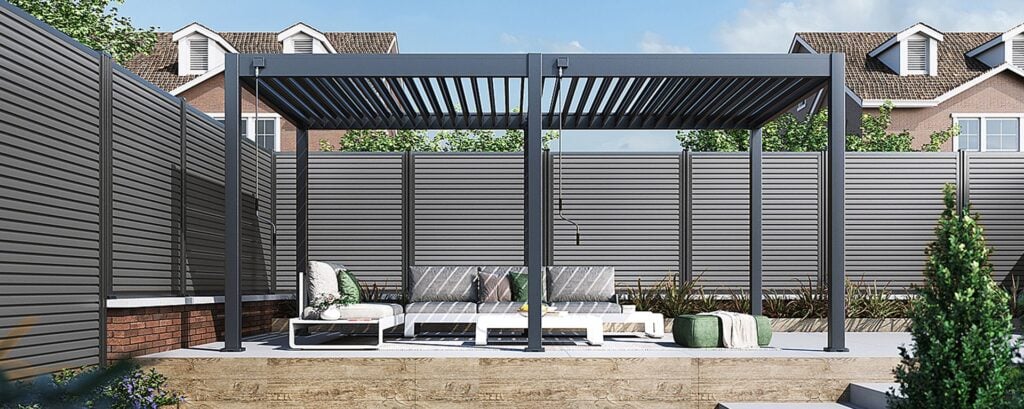
A steel pergola can be a practical choice when the project requires a controlled initial product cost, standardized dimensions, and a straightforward manual roof system.
Cost-conscious product positioning
Steel components can support economical pergola configurations, particularly where the product uses standard sizes, simplified roof operation and a freestanding layout. This makes steel pergolas relevant to residential patios, garden seating areas, retail product lines and price-sensitive outdoor shade projects.
Structural stiffness
Steel offers high stiffness and can support compact structural sections. However, the finished performance of a pergola cannot be judged from the material name alone. Profile dimensions, wall construction, connections, spans, post layout, base plates and anchoring all affect the complete structure.
Manual adjustable roof options
A steel louvered pergola can provide adjustable shade and ventilation without motorized components. This can be useful where the buyer prefers mechanical simplicity or where electrical preparation is not required.
Standardized production and packaging
Standard-size metal pergolas can simplify component planning, repeat production, packaging, and inventory control. For distributors and retailers, standardized configurations may also make product positioning and replacement-part planning more manageable.
A heavier structure is not automatically a stronger installed pergola
Product weight does not replace structural verification. Wind performance and stability depend on the complete configuration, including roof position, exposed area, frame geometry, connections, anchoring, foundation and local site conditions.
What Should Buyers Know About Steel Corrosion Protection?
Carbon steel requires a suitable protective system because moisture and oxygen can reach exposed metal through coating damage, untreated edges, poorly protected welds, or long-term surface wear.
El ISO 12944-2 classification of corrosive environments explains why the exposure environment matters when specifying corrosion protection for steel structures. A dry inland patio and a coastal, humid or chemically exposed site should not automatically use the same finish specification.
El ISO 12944-5 guidance on protective paint systems also illustrates that coating selection should consider the substrate, environment, surface preparation and expected durability rather than relying only on a colour name.
Powder coating
Powder coating is commonly used to provide colour and a protective surface on outdoor metal products. The Powder Coating Institute identifies resistance to scratching, chipping, abrasion, corrosion and fading among the potential benefits of a correctly selected and applied powder-coated finish.
Actual performance still depends on:
- steel surface preparation;
- pretreatment before coating;
- powder type and outdoor weathering suitability;
- coating coverage and curing;
- protection of edges, holes and welded areas;
- handling during packing and installation;
- local humidity, salt, pollution and cleaning conditions.
Galvanized steel and duplex systems
Galvanizing may be used for selected outdoor steel structures, and a painted or powder-coated top layer can be combined with galvanizing in a duplex system. However, buyers should not assume that every powder-coated steel pergola is galvanized.
The quotation and technical specification should state the actual substrate treatment. Terms such as galvanized steel pergola, powder-coated steel pergola y stainless steel pergola refer to different material or finishing systems and should not be used interchangeably.
All-Steel vs Hybrid Metal Pergola Construction
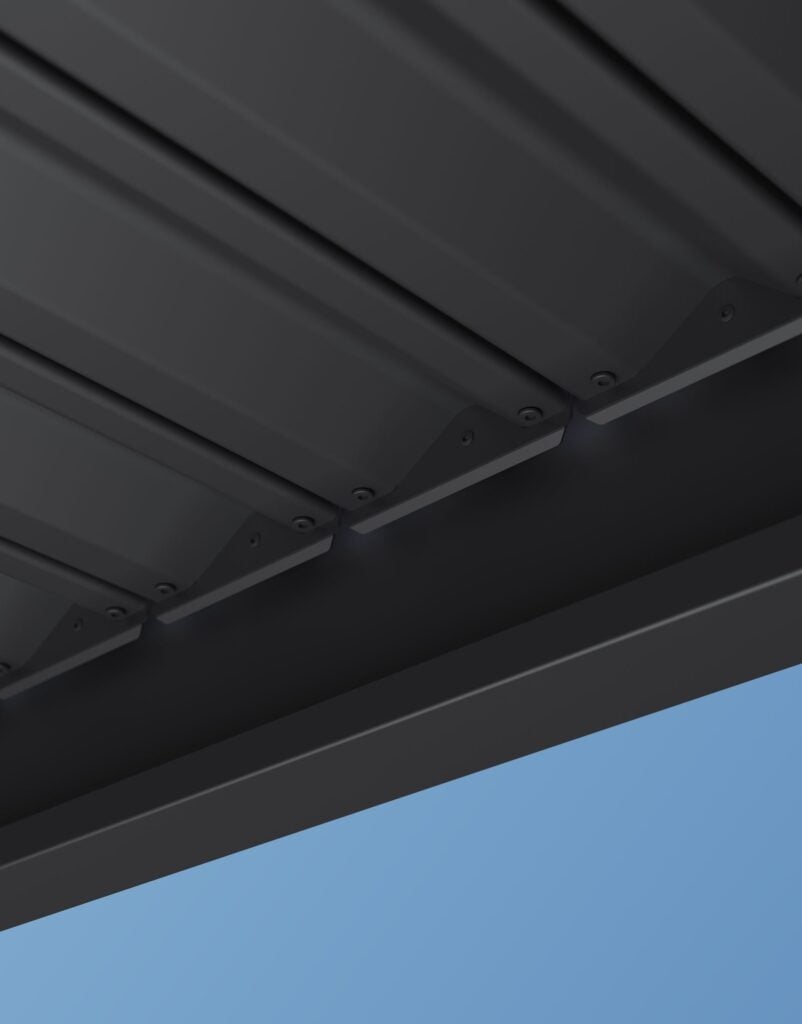
Within Outdoor Creation’s steel pergola range, ECOLINE and NEO STEEL represent two different approaches to metal construction.
| Selection factor | ECOLINE | NEO STEEL |
|---|---|---|
| Construction | Steel louvers, steel beams and steel posts | Steel louvers with aluminum beams and posts |
| Positioning | Economical all-steel manual pergola | Cost-effective hybrid metal louvered pergola |
| Roof operation | Manual adjustable louvers | Manual adjustable louvers |
| Maximum published louver opening | 135° | 135° |
| Standard size options | 3 × 3 m, 4 × 3 m and 6 × 3 m | 3 × 3 m, 4 × 3 m and 6 × 3 m |
| Published loading capacity | 30 kg/m² for the listed standard configuration | 30 kg/m² for the listed standard configuration |
| Current product positioning | Freestanding, entry-level and cost-conscious applications | Freestanding, entry-level and balanced material selection |
Published product data has defined limits
A listed loading value should not be applied automatically to every size, anchoring arrangement, side enclosure, climate or custom modification. Buyers should confirm the exact model, dimensions, roof configuration and project conditions with metal pergola manufacturers before using product data for local approval or engineering decisions.
Where Can a Metal Pergola Be Installed?
Metal pergolas are commonly considered for patios, gardens, backyards, outdoor seating areas and selected decks. The correct layout depends on the structure, foundation and surrounding building conditions.
Freestanding metal pergola
A freestanding metal pergola uses its own structural posts and does not rely on a building wall for primary support. This configuration is suitable for open patios, garden areas and detached seating zones where the foundation and post locations can be planned independently.
Outdoor Creation’s current ECOLINE and NEO STEEL louvered pergola product positioning focuses on freestanding layouts.
Metal pergola attached to a house
An attached metal pergola requires additional coordination with the building structure, waterproofing, wall interface, flashing, drainage and local approval. A wall-mounted layout should not be assumed simply because a freestanding model has similar dimensions.
The building-side connection must be reviewed according to the actual wall construction. Cladding, insulation or decorative finishes should not be treated automatically as structural attachment points.
Metal pergola on a deck
A deck installation requires confirmation that the deck structure can transfer the pergola loads into suitable foundations or supporting elements. Surface boards alone are not normally an adequate basis for evaluating anchoring capacity.
Project teams should verify post position, load transfer, drainage, waterproofing and access below the deck before selecting the final installation method.
What Size Metal Pergola Should You Choose?
Size selection should begin with the usable area, furniture layout, circulation and required shade coverage—not only with the outside frame dimensions.
3 × 3 m
Approximately 9.8 × 9.8 ft. Suitable for compact patio seating, garden relaxation or a small outdoor table arrangement.
4 × 3 m
Approximately 13.1 × 9.8 ft. Provides additional width for dining, lounge seating or a wider patio layout.
6 × 3 m
Approximately 19.7 × 9.8 ft. Supports a longer seating area or two functional zones, using additional posts in the standard configurations.
Search phrases such as 10x10 metal pergola, 3x3 metal pergola y 4x4m pergola may describe nominal market categories rather than exact finished dimensions. Buyers should review the technical drawing because external frame size, post spacing, clear internal opening and roof coverage are not always identical.
Before approving a size, confirm:
- outside frame dimensions;
- post centreline or post-to-post dimensions;
- clear internal opening;
- overall height;
- roof projection and louver direction;
- number and position of posts;
- furniture and circulation clearances;
- foundation and anchor locations.
What Affects Metal Pergola Price and Cost?
A metal pergola price cannot be evaluated accurately from size alone. Two products with similar external dimensions may use different materials, profile sizes, roof mechanisms, coatings, packaging systems, and accessory configurations.
Main metal pergola cost factors
- Material configuration: all-steel, hybrid steel and aluminum, or complete aluminum construction.
- Roof type: open frame, fixed roof, retractable canopy or adjustable louvered roof.
- Operation: manual mechanism or motorized controls.
- Size and post layout: larger spans and additional roof zones require more components.
- Surface treatment: preparation, protective coating and project-specific corrosion requirements.
- Accessories: screens, curtains, lighting, side panels, glass or other enclosure components.
- Customization: non-standard dimensions, colors, machining or branded packaging.
- Packaging and freight: product weight, carton count, loading efficiency and destination.
- Installation: foundations, anchors, lifting, labor and local project requirements.
The lowest purchase price is not automatically the lowest project cost. Buyers should also consider coating maintenance, handling, replacement components, installation complexity and the expected service environment.
How Should Buyers Evaluate a Metal Pergola Before Ordering?
A product photograph can show design and color, but it cannot confirm the complete material specification, internal connections, coating process, structural data or packaging arrangement.
| Inspection area | What the buyer should confirm | Useful evidence |
|---|---|---|
| Material | Material used for louvers, beams, posts, brackets and fasteners | Specification, BOM and component drawings |
| Dimensions | Overall size, profile sections, post spacing and roof layout | Approved drawing and measurement records |
| Surface finish | Color, texture, pretreatment, coating process and repair expectations | Approved sample, process records and inspection results |
| Roof operation | Manual travel, louver angle, alignment and freedom from interference | Trial-assembly record and operation video |
| Structure | Published load data, span, post configuration, connections and limitations | Technical data and applicable engineering documentation |
| Installation | Foundation, base plate, anchors, drainage and local responsibilities | Installation manual and site-specific review |
| Packaging | Surface protection, carton grouping, hardware, labels and loading plan | Packing specification and pre-shipment inspection |
Buyers developing an inspection plan can also review Outdoor Creation’s pergola quality-control checklist. Although that guide focuses on aluminum systems, its principles for approved specifications, machining, coating, trial assembly, operation, packaging and shipment evidence are also relevant to steel and hybrid metal pergolas.
Which Outdoor Creation Metal Pergola Is the Better Fit?
Choose ECOLINE when an all-steel structure is the priority
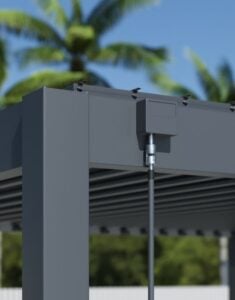
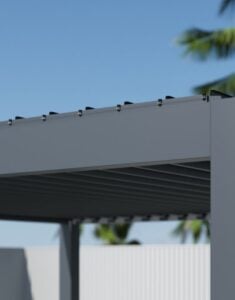
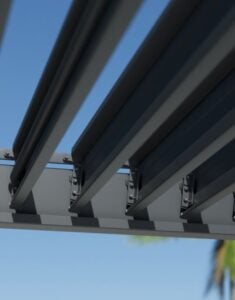
El ECOLINE all-steel manual louvered pergola combines steel louvers, steel beams and steel posts in a freestanding structure.
It is the clearer choice when the project requires:
- an economical all-steel pergola;
- manual roof operation;
- standard 3 × 3 m, 4 × 3 m or 6 × 3 m sizes;
- a freestanding patio or garden layout;
- straightforward adjustable shade and ventilation;
- controlled product cost without electrical roof components.
Choose NEO STEEL when a hybrid metal structure is preferred
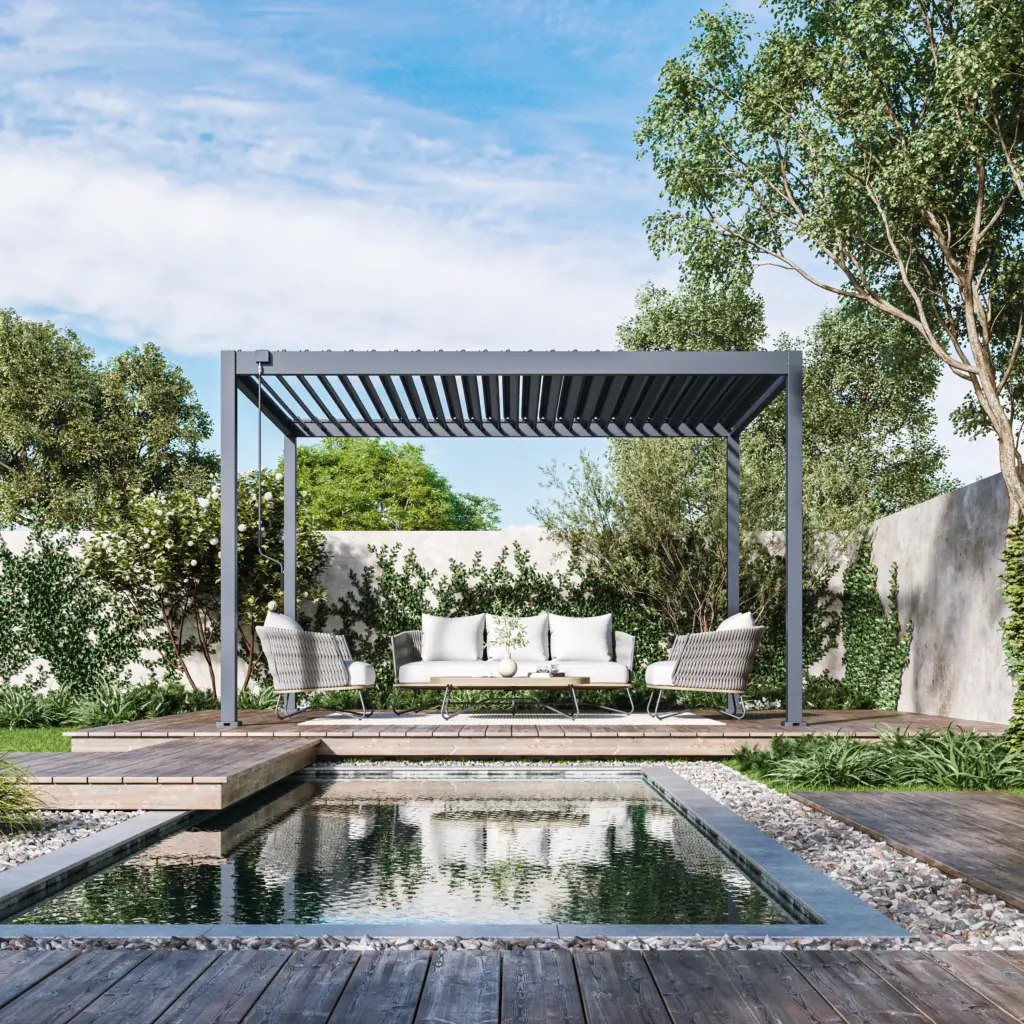
El NEO STEEL metal louvered pergola uses steel roof louvers with aluminum beams and posts.
It is more suitable when the project requires:
- steel louvers with an aluminum visible frame;
- manual adjustable roof operation;
- standard freestanding sizes;
- an entry-level metal pergola positioned between all-steel and all-aluminum systems;
- a balance between controlled cost, appearance and routine maintenance.
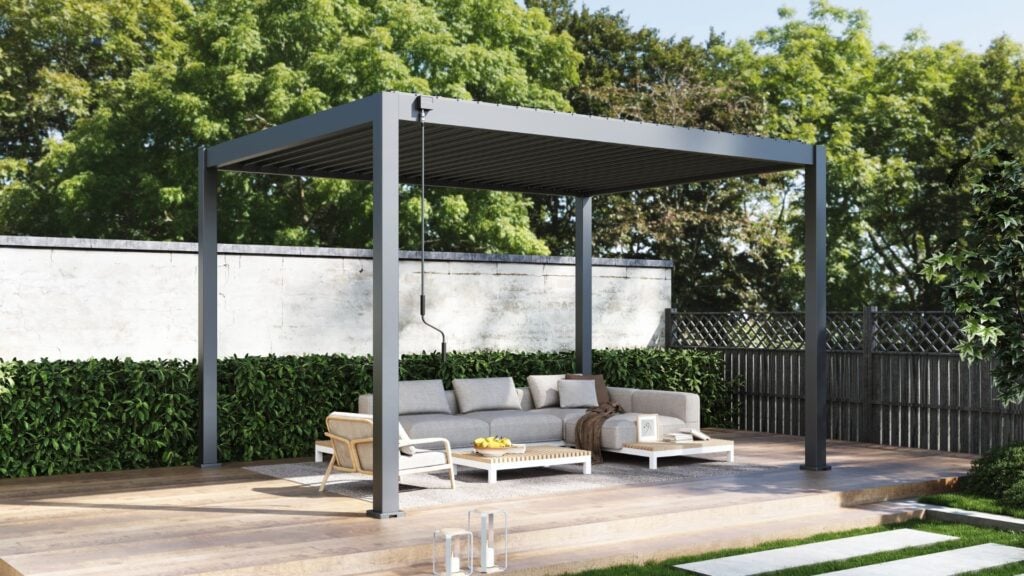
When neither steel model is the correct choice
Projects requiring motorized roof control, advanced accessory integration, wall-mounted configurations, larger engineered spans or reduced steel-corrosion maintenance may need an aluminum pergola platform instead. Product selection should follow the complete project requirements rather than one material keyword.
Final Metal Pergola Selection Checklist
- Confirm whether the product is all-steel, hybrid, or all-aluminum.
- Identify the exact roof type and operating method.
- Verify the material and dimensions of the louvers, beams and posts.
- Confirm the actual surface-treatment and coating process.
- Review standard sizes and clear usable dimensions.
- Check whether the layout is freestanding or designed for wall mounting.
- Request structural data applicable to the selected configuration.
- Confirm foundation, anchoring and local approval responsibilities.
- Review corrosion exposure and maintenance requirements.
- Confirm compatible side panels, curtains, lighting or other accessories.
- Define the inspection, packaging and replacement-part requirements.
- Compare total project cost rather than only the initial product price.
Choose a Metal Pergola by System, Not by Name Alone
A metal pergola can be an open frame, a fixed-roof structure, a retractable canopy system or an adjustable louvered pergola. A steel pergola may use complete steel construction or combine steel roof components with an aluminum frame.
This distinction matters because material terminology alone does not define roof operation, corrosion protection, structural performance, installation method or maintenance.
For a cost-conscious freestanding project, an all-steel manual pergola such as ECOLINE may provide the most direct solution. For buyers who prefer steel louvers with aluminum beams and posts, NEO STEEL offers a hybrid alternative. Other projects may require a more advanced aluminum pergola system.
The correct decision begins with the installation site, roof function, dimensions, climate, operating method, coating requirements, and expected service conditions. Once these factors are defined, the term “metal pergola” becomes a useful product category rather than an incomplete purchasing specification.
Compare Outdoor Creation Steel Pergola Systems
Share your required size, drawings, target market, installation environment, roof operation, color, packaging, and project requirements with the Outdoor Creation team.
Product dimensions, loading values, roof configurations and available options vary by model and order. Published information should be confirmed against the current product specification, approved drawings and project requirements before purchase or installation. Local structural, foundation, anchoring and approval requirements remain subject to the installation jurisdiction and responsible project professionals.