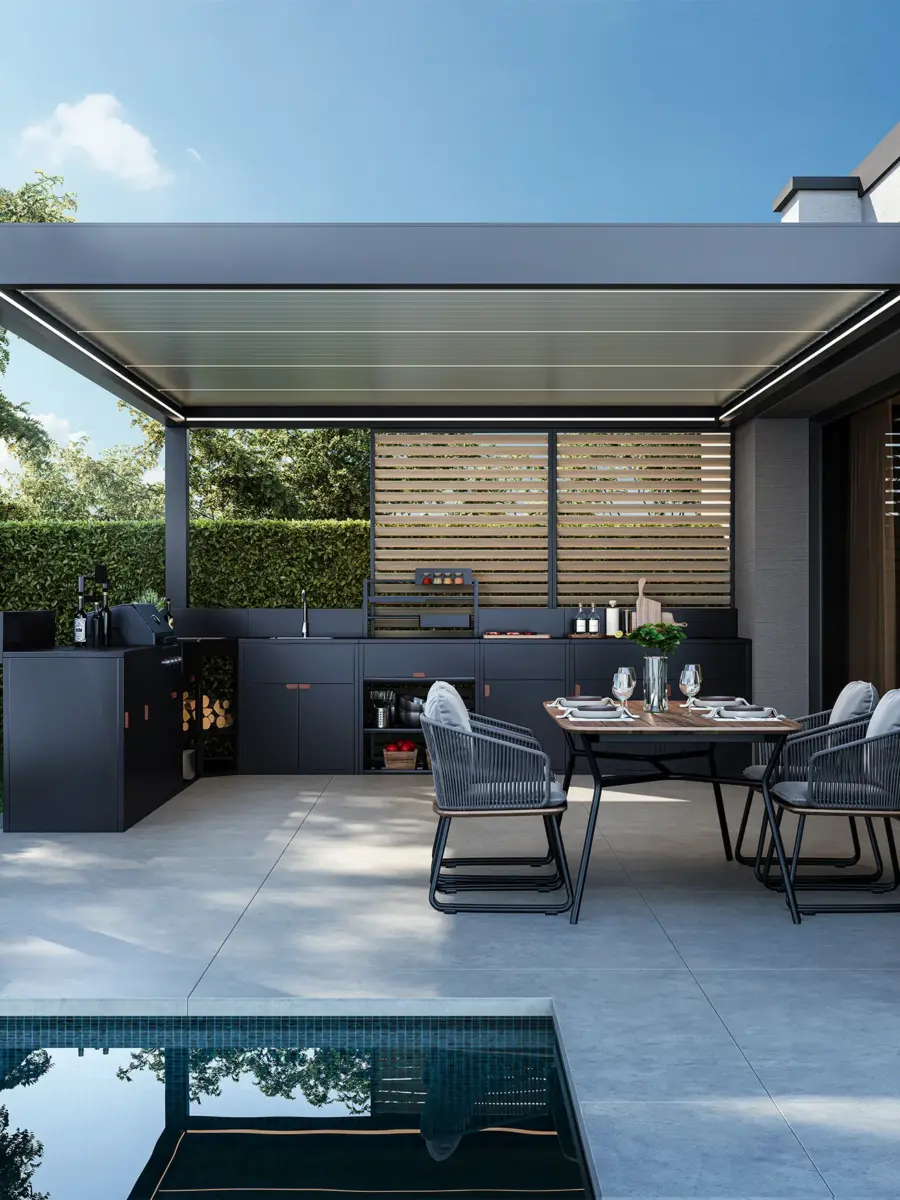
A manual louvered pergola uses a hand-operated mechanism to turn its roof louvers. A motorized louvered pergola uses an electric drive and the controls specified for that roof. For a dealer quoting a patio or terrace, this choice can change the equipment list, site preparation and handover. Start with one layout and the same accessory requirements for both quotes. The comparison below shows which details to ask the supplier to confirm before ordering and which tasks belong to the installation team.
 INTRO DUO split-roof manual pergola
How Manual and Motorized Roofs Operate
Compare hand operation with powered roof adjustment
In a typical manual system, the user turns a crank and a mechanical linkage transfers the motion to the louvers. The hand input and the operable roof area are both part of the layout. Ask where the supplied handle engages, how it is stored, and which set of louvers it moves. On a divided roof, identify the operation point for each section on the drawing. Ask for the owner's operating instructions with the quotation so you can explain the proposed arrangement during a showroom demonstration.
With powered adjustment, the control sends a command. The drive supplies the movement, and the roof mechanism turns the louvers. An electric linear actuator is one way to achieve that motion. For an application example, see the LINAK technical overview of electric actuators for pergolas.
Confirm the quoted operating interface and check what one command moves. A control location, the number of roof sections shown on a plan and the number of independently selectable zones describe three separate things. Ask the supplier to show their relationship using the selected configuration. A dealer can then demonstrate the operation the customer will receive and quote the hardware that supports it.
Roof operation changes how a user selects an angle. Roof geometry, installation conditions and product documentation determine what settings and uses are supported. Share the separate guide if a buyer also needs to understand how adjustable pergola louvers manage daylight and airflow.
- Hand crank. The user supplies the turning force.
- Manual mechanism and linkage. The mechanism transfers motion from the crank to the louver pivots.
- Roof louvers. The blades rotate on their pivots.
- User control. The selected control sends a command to the drive.
- Powered drive and linkage. The drive moves the linkage to adjust the blades.
- Roof louvers. The blades rotate on their pivots.
Check who uses the roof and where they stand
On one patio, a homeowner may set the louvers before sitting down and leave them there for a meal. On another, staff may change the setting repeatedly as the terrace fills and the shade moves. Work through these routines with the customer. Put the operating point on the furniture plan and then check whether chairs, dining tables, planters or side panels block the route when the terrace is occupied. The same check can expose awkward positions for a crank or a wall control.
Also confirm who is expected to use the control and what reach and clearance the project requires. For applicable US projects, the guidance covers both the approach to fixed controls and the space to operate them. Check these conditions against the finished layout and the U.S. Access Board guide to operable parts.
At a site survey, show the customer the proposed operating position as well as the roof footprint. Ask whether each user should be able to operate the whole roof or only the assigned section. For multiple installations with rotating staff, record where controls are kept, who takes charge of them, and how a new operator identifies the correct unit. Frequent adjustment can make powered operation worth considering. A reachable crank and a familiar operator can make manual operation a good fit for a roof adjusted occasionally.
Repeat the check from the entrance used during service. A control that looks convenient on the plan can end up behind a lowered screen or on the far side of a seating row. In a showroom or first installation, ask a representative user to demonstrate a normal change of shade setting with the furniture and screens in the expected positions. Record any change needed before handing over the controls.
What Power and Controls Need to Be Specified
Request the power and control documents for the quoted roof
Ask the supplier to identify the exact drive, control equipment and user interface for the order. Request the model documentation that defines the equipment requirements, connection points, operating conditions and commissioning procedure. Use the current drawing and equipment list to reconcile project responsibilities before paving, cladding or other finishes limit access. The draft quote should show what the factory can supply and what the project team has to arrange on site.
Give the electrical contractor the manufacturer documents for the actual roof and any separate powered accessories. Have the responsible project team confirm the applicable local requirements, installation and later service access. Electrical work requires planning and competent personnel, as explained in the UK Health and Safety Executive guidance for work on electrical installations and equipment.
On a finished terrace, ask the site team to identify which surfaces or building elements can be accessed and when that access is available. On a new terrace, review the same information before the surrounding work proceeds. In either case, write down the person responsible for confirming the prepared location and the date when the installer can check it. If the customer wants to add powered lighting or screens later, capture that request and get a model-specific response before deciding what to prepare now.
Assign a person to confirm that ordered controls, labels and product references agree when the shipment arrives. Dealers managing repeat installations can use a common document format while keeping each site's roof and accessory references on its own order. That makes it easier to trace which equipment was supplied when two jobs use the same series name with different fittings. Keep the installation handover tied to the same references so a replacement request can be checked against the original order.
Ask how the selected system behaves when power is unavailable
Request the documented response to loss and restoration of power at the quotation stage. Find out what the user should do if an adjustment is interrupted, whether the selected product has a documented manual or backup provision, and which steps require an installer. Ask for a plain description that can go straight into the customer's handover. Equipment behavior can vary with configuration, so terms such as motorized or remote controlled leave this question open.
For a manual pergola with powered accessories, ask two separate questions. Can the user still operate the roof by hand under the conditions stated in the manual? Which accessory functions require power and what instructions apply when power returns? At a commercial site, decide who receives any service call and who can identify the affected equipment. Note the quoted provisions and responsible contact beside each relevant function on the order.
Make the handover wording specific to the audience. A homeowner needs to know how to identify the affected function and where to find the operating instructions. A facilities team may also need the roof section reference, the site contact and the equipment list for the unit. Ask the dealer to keep the model and order details where the site team can retrieve them even after the original installer has left.
Separate Roof, Screen and Lighting Controls
Give each controlled function its own specification line
Build an order schedule that lists the roof, side screens and lighting independently. A roof line should identify the mechanism, roof sections and operating interface. A screen line should identify the elevation, approved screen type and manual or powered operation. A lighting line should identify the location, control option and any equipment supplied for that option. This format captures what the dealer will demonstrate and what the installer will commission. For accessory and remote-control terminology, see the pergola motor and accessory FAQ.
For a covered dining terrace, a customer might want to lower a side screen independently while the roof stays at its current angle, then switch on lighting once service begins. Use the routine to ask precise questions about the quotation. If the supplier proposes a handset or other shared interface, ask which buttons operate which functions and confirm whether the required components are in the order. If the equipment uses separate controls, show their locations and label each one for handover.
Give the same schedule to the installer and the aluminum pergola manufacturer for manual and motorized projects so both can check the selected equipment against the plan. Record the decisions beside the relevant roof or accessory line and note the approved revision. A later change to a screen should be checked against the selected frame and installation details, including any effect on access to the roof's operating point.
Use INTRO DUO to verify a manual roof with independent accessories
INTRO DUO with a manual split roof has a central beam dividing the roof into two louvered sections. Its roof is hand-operated. The series lists compatible powered accessories, including motorized wind screens and beam LED lighting. A quoted INTRO DUO with a powered screen therefore has a manual roof entry and a separate powered screen entry. Verify the compatible opening, control and equipment for the proposed screen and lighting on that configuration.
- First roof zone. One louver group on one side of the center beam.
- Second roof zone. The second louver group sits across the center beam.
- Hand crank. The roof is hand-operated. Confirm crank locations for the selected size.
- Optional electric side screen. Specify its control and power separately from roof operation.
- Optional beam light. Confirm the lighting hardware and its control separately.
For a dealer preparing an INTRO DUO quote, start with the freestanding roof and the two roof sections. Mark the area to be screened by elevation and identify where lighting is requested. Confirm each proposed accessory against the chosen size, then have the responsible installer check access to the hand-operated roof with that screen in place. Retain the marked elevation with the order. It identifies which screen the customer specified, especially when several sides look similar in a scene photograph.
Compare Like-for-Like Configurations and Service Support
Compare NEO ALU options against one roof brief
Start with NEO ALU with manual or optional motorized roof control. It is one series in our range of aluminum louvered pergolas with different roof control options. Use the same footprint, mounting arrangement, roof zones, accessory list and intended use for both inquiries. Ask whether the project conditions can be met with each operating option. If the available layouts differ, request the differences in writing and carry them into the comparison before looking at price.
Use a comparison table at the quotation stage. Once the proposed configuration is selected, its documents should be specific enough to turn the same checks into acceptance items for the dealer and installer.
| Project check | Manual roof | Motorized roof |
|---|---|---|
| Operation position | Verify crank location and working clearance. | Verify the interface and where the operator uses it. |
| Frequency of adjustment | Walk through a typical day's handle access and storage. | Walk through a typical day's controls and zone selection. |
| Power and controls | Record hand operation and identify any separately powered equipment. | Obtain the specified drive and control documents and assign site power responsibility. |
| Screens and lighting | List each option, opening or position and its own means of operation. | Ask whether the quoted controls operate each accessory independently or through an agreed interface. |
| Handover documents | Match the roof hardware, user instructions and drawings to the order. | Include the equipment references, user instructions and commissioning documents for the selected roof. |
| Service owner | Agree who checks the roof mechanism and orders replacement parts. | Agree who handles controls, drive support and any site electrical work. |
When a quote returns, ask the supplier to identify the common items first, then show the equipment and work associated with each roof option. For example, a screen selected for the same opening should appear by the same name in both offers if both configurations support it. If a roof-control choice changes any accessory, drawing or installation task, mark that line as a changed item. Compare prices after the list reflects the proposed scope at the site.
For the powered NEO ALU choice, ask for the drive and controller references on the selected order. The separate pergola louver motor product page identifies its supported models. Use the NEO ALU configuration documents to confirm its drive pairing and any proposed upgrade of an installed roof. Dealers can then describe the ordered system accurately and establish which part references the installer will need later.
Use INTRO DUO and PRESTIGE to confirm the limits of each series
INTRO DUO illustrates a manual split roof with separately selected accessories. PRESTIGE with a motorized aluminum louvered roof is a motorized-only roof series with optional lighting. For PRESTIGE, use the selected layout and order documents to verify which controls, lighting components and other parts come with the installation. These two series illustrate distinct roof and accessory arrangements, so use the drawings and option lists of the series you intend to quote.
 PRESTIGE motorized louvered pergola
The distinctions matter when a developer compares offers across multiple patios. At a unit where the owner wants to operate the roof by hand and use powered side shading, record both requirements early. At a unit that needs powered roof operation, specify the required control point and confirm who will prepare the site for installation. For each offer, list the layout and the accessories alongside the control choice. A side-by-side review then shows which requirements are matched and which need design or price approval.
Confirm documentation, spare parts and service access
Before approving the order, request the operating guide, the maintenance items that apply to that roof, and the identifiers needed to request replacement parts. Ask for service access requirements on the installation drawing. A manual mechanism needs sufficient access to inspect its moving hardware. For a motorized configuration, ask how the installer identifies and accesses the drive and control equipment under the documented service procedure, especially if an adjacent finish or accessory might obstruct access.
For buyers maintaining a portfolio of installations, ask which replacement parts can be ordered individually and which have to be matched to an assembly. Record any model or revision reference the supplier requires. If the site orders spare handsets or handles, have the supplier identify where they can be used and how site staff should label them. This helps a dealer verify a replacement request against the installed unit when later orders within the same series have different controls.
When sourcing from a louvered pergola factory that supports model selection and project orders, send the dimensions, mounting arrangement, roof drawing, accessory schedule and intended operation together. Record the order number, installed configuration and agreed contacts in the handover pack. On the first installation of a repeat order, have the responsible installer demonstrate each ordered roof and accessory function, then use the same checks for subsequent units. A clear record helps the dealer route a service request to the appropriate party with the information required to identify the equipment.
Frequently Asked Questions
Does a motorized pergola roof need electricity?
Yes. The roof drive and controls need their specified power supply. A hand-operated roof moves manually. Powered screens or lighting still need their own specified supply and controls.
Can a manual roof have powered side screens?
Yes, if the chosen pergola configuration supports the screen. Confirm the screen size, mounting, power and controls separately from roof operation.
Do all sizes use the same roof controls?
Controls can vary by size and layout. Confirm the operating mechanism, interface and roof zones against the drawing and equipment list for the quoted configuration.
What happens to the roof during a power outage?
Behavior varies by configuration. Follow the selected system's instructions. Ask the supplier to confirm how operation resumes and whether it includes an approved backup or manual release.
What should dealers confirm before ordering?
Confirm layout, mounting, roof operation, accessories, controls, site responsibilities and service access. Ask for the drawings and equipment references that match the written order.
Pergola projects can be customized. Available materials, mounting hardware, roof controls, accessories, installation requirements and final specifications are subject to confirmation for each project and order.