
Before shipping a modular outdoor kitchen, link each cabinet, worktop and accessory to the package that will carry it and agree where the carrier hands it over. Give the receiving team the package list, packed dimensions and weights, and the agreed unloading responsibilities before dispatch. A retailer may receive the right number of cartons and still be missing the worktop for a particular order. A packing list tied to the confirmed configuration lets the receiver identify that gap before the installer schedules the next stage.
Define What Will Ship With the Kitchen
Confirm the Order and the Assembly State
Start from the approved order revision and name the person who can approve a change. The importer needs cabinet references, worktop sections and separately supplied items to carry through to the shipping records. The retailer needs the receiving location and the identifiers its staff can recognize on arrival. The installer needs to know how the items will arrive and which pieces must be present before each stage can proceed. Use the same confirmed order for all three decisions. Compare modular outdoor kitchen systems by configuration when confirming which modules belong in the order.
Record the confirmed assembly state for each ordered module and list the parts packed separately. For a cabinet, establish which doors, drawers, shelves or handles are fitted and which are supplied loose. For a worktop, confirm its sections and whether the order specifies shipment fitted to a cabinet or as a separate package. Give a separately purchased appliance its own supplier, delivery reference and receiving status. The kitchen's layout can show where it will go, and the order lines determine which party supplies it. Apply the same separation to the other outdoor product ranges in the project when the buyer arranges them to arrive together.
Make the scope legible for the person who receives the order. Give them the model or component reference, the expected quantity and the finish where it distinguishes similar items. If there are optional accessories or owner-supplied items, mark how their arrival will be tracked. Agree whether their arrival is needed for receiving the kitchen, releasing it to the installer or completing later work. Recording those dependencies early makes it easier to describe what is still outstanding when the delivery arrives.
Turn Order Lines Into a Packing List
Translate the order into the handling units the warehouse actually expects. Ask for the external package ID, order reference, module or component references inside, and assigned delivery destination. Include the packed dimensions and gross weight for each unit the receiving team will handle. One order line may be divided across packages, and one package may hold pieces for several lines. If cartons are carried together on a pallet, the receiving team should be able to distinguish the pallet ID from the carton IDs underneath it.
For the illustrative order K-104, the approved packing list Rev B shows P01 for a cabinet, P02 for the worktop and P03 for hardware. All three are booked to the retailer's warehouse. The receiver expects three packages and needs to match each one to its order line before it can inform the site team. If an identifier or package grouping changes after Rev B is issued, give the warehouse the revised record before it receives the load. The same file should follow the job if a warehouse colleague takes over the appointment.
- 1. Confirm the order. The buyer and supplier agree which modules, worktops and accessories will ship, and in what assembly state.
- 2. Match parts to packages. The packing team issues a packing list that links order lines to package IDs and includes packed dimensions and gross weights.
- 3. Check the receiving point. The logistics coordinator and receiver confirm the handover point, access, unloading responsibility and current packing list.
- 4. Reconcile the delivery. The receiver checks package IDs, count and visible condition, then records the status by package.
5. Decide what can move to installation
- Required checks completeThe receiver and installer confirm which work has the parts it needs. Record the packages released for that work.
- An exception remains openThe receiver keeps affected goods or work on hold, assigns a reviewer and updates the handover after verification.
Designed and created by the Outdoor Creation team.
Confirm the Protection and Identification of Each Package
Identify the Surfaces and Edges That Need Protection
Ask which visible surfaces, edges and projecting parts the packing specification protects and how the receiver can identify them at the agreed inspection stage. Use the approved finish and component records to describe the item. A photo can illustrate what the surface looks like. The order-specific packing information tells the recipient how the item is grouped and which marking identifies the package. For separately packed worktops, request the supplier's instructions for the exact item and how it is packed for the trip.
The NOVA compact outdoor kitchen with galvanized steel cabinets illustrates how a cabinet finish, shelf and handle help a receiver recognize the configured item once the applicable inspection is complete. NOVA uses galvanized steel for the cabinets and worktops. The series includes wood-grain handles, and the product photographs show details a buyer can reference when recording the specified finish or part. Use the approved order to identify which details are present on the unit being delivered.
 NOVA Outdoor Kitchen in a Poolside Setting
 NOVA Wood-Grain Prep Surface
 NOVA Galvanized Steel Shelf
 NOVA Wood-Grain Cabinet Handle
The ELITE modular outdoor kitchen with a sintered stone worktop pairs a sintered stone worktop with composite cabinet construction. Its photos show features to reference during an agreed visual check, such as the worktop edge, appearance of the surface and cabinet hardware. Identify the required edge finish and any openings in the confirmed configuration. For the receiving plan, request the condition checks and instructions for that particular assembly or separate pack.
 ELITE Outdoor Kitchen in a Terrace Setting
 ELITE Stone Worktop Edge and Wood Trim
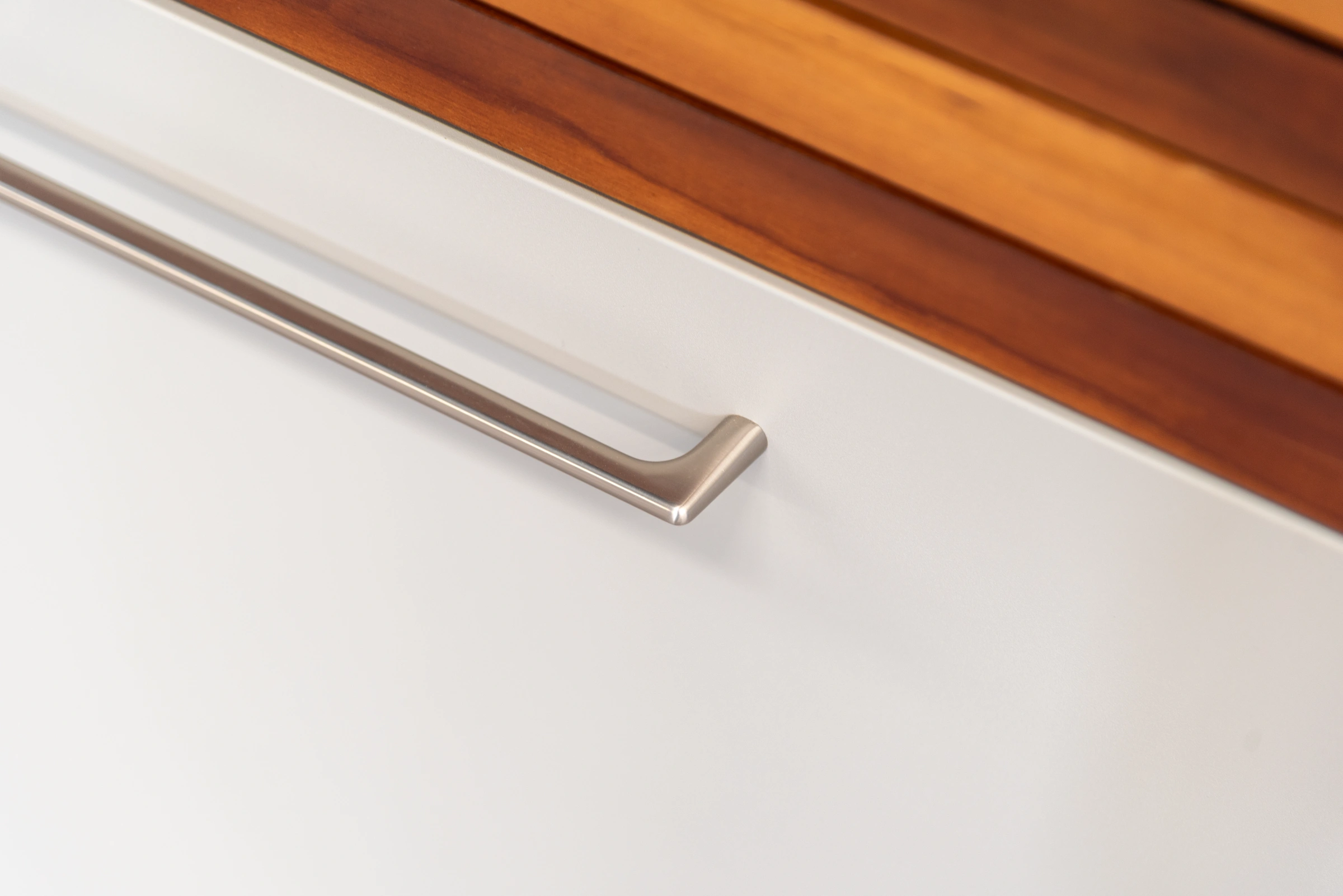 ELITE Cabinet Door Handle
 ELITE Dark Sintered Stone Veining
Use the same comparison for AXIS open shelf modules in galvanized steel, URBAN outdoor kitchen cabinets in aluminum or METRO kitchen modules with 304 stainless steel worktops. Record features relevant to the confirmed model and specify which belong to the cabinet, a separate worktop or a hardware package. Keep the approved identification and finish references with the shipment record, so the warehouse can retrieve them when a package looks similar to another unit on the same delivery.
Agree Package Labels and Shipment Records
When labelling cartons for outdoor kitchen cabinets and worktops, decide how each label will distinguish both the order and the package within it. Confirm the relationship between the supplier's module code and the retailer's inventory code. Give the receiving team a way to see the expected finish, destination and status behind an identifier. Ask a modular outdoor kitchen manufacturer for multi-carton orders how it will communicate a changed package reference or a revised grouping after the list has been issued.
If the trading partners use GS1 logistics labels, confirm who assigns the Serial Shipping Container Code, how the warehouse obtains the corresponding shipment record and when it scans or checks the unit. A shared identifier helps the receiver locate the associated information. Keep the contents and order-line details in the agreed shipment data. The record should remain useful for any packages the warehouse must verify individually, including small hardware boxes or worktops addressed to one delivery but held with another. GS1 guidance on logistics unit identification.
Check what the receiving team can read at each stage. The carrier may see only the label on a grouped handling unit. Warehouse staff may need the identifiers on individual packages before putting items away or assigning them to an order. For any small package that travels inside another, record its parent package on the list and agree how it will be accounted for when opened under the receiving procedure. That lets the warehouse distinguish an expected inner package from an item due on another delivery.
Illustrative order K-104 · Packing list Rev B · Retail warehouse
| Expected item and package | Arrival check | Receiving action |
|---|---|---|
| Cabinet · P01 | MatchedLabel agrees with K-104 and Rev B. | Record receipt. Check worktop dependencies before installation release. |
| Worktop · P02 | UnconfirmedNo verified match for K-104 P02. | Keep worktop-dependent work on hold until P02 is verified. |
| Hardware · P03 | MatchedLabel agrees with K-104 and Rev B. | Keep with the order and confirm which work can proceed. |
| Unexpected package | Different order IDLabel refers to another order. | Record the actual label and hold this package for review. |
The package count agrees even though P02 remains unconfirmed. Share both entries with the logistics contact so each can be traced independently.
Designed and created by the Outdoor Creation team.
Record the Packing Evidence Before Dispatch
Put the dispatch copy of the packing list, agreed label records and any required packing photos where logistics and receiving can find them. Include the issue date and revision. If the buyer requires packaging tests, agree what configuration and distribution conditions the evidence covers. The International Safe Transit Association lists different procedures by test purpose and shipping scenario. Ask for the relevant report or other agreed evidence for the shipment under review. ISTA test procedures.
At Outdoor Creation, the factory coordinates components and modules with the order and uses protection planned for their shape, finish and assembly needs. Confirm the package breakdown and delivery documents with the order contact before dispatch, especially if a late configuration change affects the worktop or accessories. For a small trial order, discuss the configuration, quantity and service needed so both teams can confirm the package information and the delivery scope for that shipment. Read about outdoor kitchen order preparation and packing at our factory.
Prepare the Delivery Point and Receiving Route
Agree Where the Carrier Hands Over the Load
Record the exact place and service included in the delivery agreement. A port, warehouse loading bay, curbside or kerbside point, and installation site each bring different receiving arrangements. For the agreed point, confirm who books the appointment, who receives the goods, who is responsible for unloading and who arranges any onward move. If one party delivers to the warehouse and another takes goods to the job site, give both teams the appropriate job references and a named receiver for their leg.
For K-104, the carrier's handover ends at the agreed retail warehouse. The retailer assigns the receiving lead and arranges site delivery separately. Give the carrier the unloading address, any stated vehicle restrictions and the agreed appointment contact. The site team can reserve space against a provisional plan, then schedule the onward delivery once the warehouse reconciles the packages needed for the next stage. Keep the transport booking and the installer schedule linked by order reference so a change reaches the right people.
Keep the warehouse and site checks distinct. The warehouse may have a suitable loading bay and storage location, while the site may have restricted access or limited room to stage the same packages. Confirm what will be moved onward, in what packaging, and where the site team will receive it. If the onward delivery is planned around a smaller set of packages, give that carrier the actual envelope of that load and a separate destination contact.
Match Packed Dimensions and Weights to the Site
Share the dimensions and gross weight of the packages or handling units with the responsible receiving team. Include any supplier instructions for orientation, protection or packaging that apply to the exact goods. Ask the local team to review the agreed unloading point, the route to the staging area and any change of level, doorway or turn along it. Use the packed envelope for route planning since a cabinet's finished dimensions and its dimensions in a handling unit can differ. If an item is held for verification, check that a suitable receiving location is available under the site plan.
Send changes to the party planning the operation before the goods arrive. The qualified receiving team determines the handling method, people and equipment for the load and site. For example, the UK Health and Safety Executive's manual handling guidance explains that its risk filters use general assumptions and do not establish safe lifting weight limits. Request the shipment-specific packing and handling information for the people responsible for assessing the move. HSE manual handling risk filters.
Illustrative plan. Confirm the carrier’s handoff point, the packed dimensions and who is responsible for onward movement.
- Handoff. Confirm the delivery point and unloading responsibility.
- Receiving door. Check the opening and threshold against the packed load.
- Turn. Compare the reported package envelope with the available space.
- Staging. Agree where packages can wait before their next check or transfer.
Designed and created by the Outdoor Creation team.
Check the Delivery and Release the Right Items
Reconcile the Packages Before Installer Handoff
At the agreed handover, record what actually arrived and compare it with the packing list revision used for dispatch. Check the number of handling units, their visible identification and their observed condition within the agreed receiving procedure. For a relevant container or other transport unit, the parties may also need to record its visible condition and compare the seal with transport documentation. The joint CTU Code provides guidance for the receipt and unpacking of cargo transport units. Apply it where relevant to the shipment and follow the agreed local receiving procedures. IMO, ILO and UNECE CTU Code.
At the warehouse in the K-104 example, the receiver records three packages. P01 and P03 match Rev B. The third package carries a different order reference, so the receiver records its observed label separately and leaves receipt of P02, the expected K-104 worktop pack, unconfirmed. The supplier and receiving lead check the discrepancy. The installer is told which packages match and which installation activities still depend on the worktop.
Record Shortages or Visible Damage by Package
Record a missing package, a conflicting label or visible damage against the affected package and order line. Include the delivery reference, receiving date, label information and any observations or photos collected safely under the receiving procedure. Use an open status for items that have still to be checked, and send the record to the named contacts. Batch arrivals or supplier changes can account for a discrepancy, so keep the expected and observed records side by side until the responsible parties confirm the outcome.
Agree who can clear the exception and what evidence they need. In K-104, the supplier can check its dispatch records and the retailer's receiving lead can confirm the package identity from the evidence authorized for that delivery. A corrected dispatch record can resolve a label error if the goods are verified. If the worktop is for another order, record the incorrect unit separately and keep the K-104 worktop pending. Follow the applicable carrier and purchase terms for reporting damage or shortages and any formal acceptance decision.
Keep the original label reference, the expected package ID and the later confirmation together. A newly printed label or an updated warehouse entry is useful only when it can be traced to the verified order and contents. Record which information the supplier confirmed, which checks the receiving team completed and who cleared the item for the next stage. This preserves the reasoning if a different shift or the site team picks up the order before the delivery exception is closed.
Which exception is blocking release?
- Label mismatch
Record: The label seen, expected package ID and packing list revision.
Notify: The buyer or logistics contact named for discrepancies.
Clear: The reviewer confirms the package identity and order assignment.
- Package still outstanding
Record: The expected ID, affected order line and delivery reference.
Notify: The order contact and the team whose work depends on it.
Clear: Confirm the missing package on arrival and update the handover record.
- Visible damage
Record: The package ID, visible condition and photos if safe to take.
Notify: The contact specified in the agreed receiving procedure.
Clear: Obtain and record the reviewer’s decision under that procedure.
Limit the hold to the affected scope. In order K-104, keep the package labelled for another order and the work that needs P02 on hold. Release other work when the receiving and installation teams confirm its requirements are met.
Designed and created by the Outdoor Creation team.
Update the Warehouse and Site Handover
Send the installer a status by item or section. Mark the parts received and matched, the parts held for a discrepancy, the parts still due and the items released to the next team. A matching cabinet and hardware package may be ready for the next handover after their required checks. The worktop-dependent stage stays on hold until P02 is identified and released. If other work can proceed, agree with the site team that it has all the parts and documents for that particular stage.
When working with an outdoor kitchen supplier for retail receiving and handover, name the party that will update the packing records and the one that will notify the installation team. Send the revised status to logistics, the warehouse and the site contact together. Record who confirmed the decision, which package or work stage it affects and what still needs a response. That leaves the next buyer or receiver able to distinguish a closed delivery exception from an open installation dependency.
Modular Outdoor Kitchen Shipping FAQs
What comes with a modular outdoor kitchen kit?
Ask for the confirmed order list. Cabinets, worktops, hardware and appliances are included only if listed. A carton count alone does not confirm which items are supplied.
Will the kitchen arrive fully assembled?
Ask the supplier to state the assembly condition of each module and list worktops, accessories and any other parts delivered separately. Confirm this before booking installation.
Can I identify cabinets from the carton labels?
Yes, when the labels match an agreed packing list. Ask for each package ID, the order it belongs to and the cabinet or component references inside.
What should I check before the delivery arrives?
Confirm the delivery point, packed dimensions and weights, access route, and who is responsible for unloading. Give the receiving team the current packing list.
Do stone worktops need different receiving checks?
Ask for the exact worktop handling and inspection instructions. Confirm packed dimensions, weight and the person responsible for verifying the worktop and its package at delivery.
Can a delivery go straight to the installation site?
It can if the order and carrier agreement cover that handover. Check access, unloading responsibility, storage and the site team's availability before dispatch.
What if a package arrives with visible damage?
Record the package ID, condition and delivery reference when safe to do so. Notify the agreed contact and follow the order and carrier procedures before releasing the item.
Should installers start if an item is missing?
Confirm which work depends on the missing item. Release independent work only after the receiving and installation teams agree that the parts and documents they need are available.
Discuss Your Kitchen Order and Delivery Plan
Tell us which kitchen modules you need, where the order will be received and who will handle the delivery. Our own factory manufactures modular outdoor kitchens directly and can review the custom configuration, packing information and handover scope for your order.
Materials, hardware, installation responsibilities and order terms depend on the agreed project scope and confirmed final custom specifications.

