Before developing a private-label outdoor kitchen, agree on the existing cabinet configuration and list exactly what will change in the branding, product or packaging. For each change, confirm who approves it, what evidence they need and whether it affects other parts of the kitchen or the sales pack. Review a new logo file against the agreed artwork and labeling requirements. A different handle, worktop cutout or carton may also require drawings, a sample check or a review of packing protection.
Start With an Agreed Kitchen Configuration
Record the Reference Series and Module List
A change request needs a defined starting point. If you are launching a private label modular outdoor kitchen range, record the series name, each selected module and the drawing revision used to build the layout. Add the approved worktop, door or drawer fronts, finish references, and any separately sourced appliances or fittings. Mark the viewing direction on the layout so that the buyer and supplier mean the same thing by left and right. Give the proposed version its own identifier so the original remains available for review.
Break out the product that the customer actually buys. A kitchen may be sold as a set, as separately ordered cabinets, or as a set with separately packed options. Record which modules belong to each saleable unit, which items ship in separate cartons, and which options are ordered independently. For a display kitchen, record whether the display matches the intended saleable configuration. This prevents the showroom arrangement from becoming the warehouse reference by default. If the range is still under selection, complete the modular outdoor kitchen range planning for distributors before asking the factory to review specific changes.
Define the Market, Channel and Buyer Roles
Brand product managers often start with a logo request and add a door finish or hardware request after seeing the sample. Procurement may already be using the original product reference. Identify who owns the artwork and who can approve a physical change. A brand approver can confirm a logo proof. An engineering approver should decide how to verify a proposed change to a cabinet or appliance interface. Record both decisions if a badge or handle affects both.
Importers and channel buyers face a different handoff. The carton may arrive with a supplier reference while ordering, warehouse receipt and service rely on the buyer's item code. Provide the destination market, selling channel, language requirements, and the receiving team's label instructions before preparing artwork. Ask quality and service teams which drawings, identifiers and assembly instructions they will need once the kitchen is in use. If the order serves two channels, identify the fields shared across them and the ones requiring separate approval.
-
Set the baselineRecord the series, module list and drawing revision.
-
Describe the changeShow what would change and name the target market.
-
Assign the reviewsAgree on the checks, evidence and responsible reviewers.
-
Release for samplingApprove the brief and agree how the sample will be judged.
General sourcing workflow for the buyer and supplier.
Designed and created by the Outdoor Creation team.
Identify What Each Proposed Change Affects
Brand Artwork and Product Labels
Start by identifying what the customer sees and where. List the artwork on the cabinet, the retail label, the carton and the assembly instructions as separate items. Supply the approved artwork file, its revision, the placement and size, and the buyer's authorized signatory. Ask the supplier to confirm the available application method on the exact surface. For a proposed adhesive badge, for example, check whether the specified panel finish and exposure suit the badge and agree what a placement proof or sample needs to show. If the request includes holes or fixings, route it to the product reviewer as well.
Keep the buyer's stock-keeping unit, the supplier model reference and the Global Trade Item Number in separate fields. Under the GS1 GTIN Management Standard, a change to the primary brand on a trade item requires a new GTIN for that item and its existing higher packaging levels. In a channel that uses GS1, confirm who assigns the identifiers, which units and packaging levels are affected and where the new codes must appear. Maintain a mapping from the supplier's original configuration reference to the buyer's new item so product support can trace the order.
An importer may sell a complete kitchen while also stocking a replacement door under its own item number. Before approving the new brand, ask the channel team which identifiers it uses for the complete set, the shipment cartons and the replacement door. Ask the document owner to update the affected instruction or service references at the same time. That keeps the order traceable if a dealer later needs a part for a kitchen sold under the new brand.
Cabinet, Worktop and Appliance Interfaces
Describe the physical result you want and identify the component that would change. A new door grip might affect door geometry, neighboring drawer clearance and access. A change to a worktop opening can affect the cutout drawing, the clearance required by the appliance and the space inside the adjoining cabinet. An apparently cosmetic finish change can require review of the base material, visible edges and how adjoining surfaces look together. For outdoor kitchen cabinets, identify which sides or edges are visible in the intended layout as part of that review.
For an appliance request, provide the exact make and model, the manufacturer's installation instructions, the intended cabinet and position, and any supplied fittings that must be available when the sample is checked. Ask which dimensions and assembly interfaces the change affects. Where proposed routing or clearances involve utility connections or market-specific requirements, assign those questions to the appropriate qualified reviewer. Keep the affected work off the release list while evidence is still missing.
Sales Packaging and Transit Protection
When reviewing outdoor kitchen cabinet customization and packaging together, describe label artwork and physical protection as separate changes. If the request is to update a carton print, specify the approved file, print locations, languages and readable model codes. If the worktop, cabinet shape, weight or carton construction also changes, identify the parts that need new support, separation or handling arrangements. Include the expected route and what the receiving or fulfillment team needs to identify each package in a mixed order.
Agree whether revised packaging needs an inspection, trial shipment, or testing. The International Safe Transit Association's packaging design and testing guidance ties test selection to the actual distribution situation and representative product and package samples. Apply that principle to the planned shipment. A change to the balance of a loaded carton or the protection on a stone worktop edge merits a different review from a print change that leaves carton construction and handling intact.
If the channel requires cartons to be split at a warehouse or sent directly to separate customer addresses, ask the receiving team what it needs on each label to reunite the right packages at the job site. Check how the order number, configuration reference and carton sequence will appear. Include a readable carton proof in approval and ask the warehouse team to test a sample label in its receiving process if scanning is part of that process.
| Change | Check against the baseline | Evidence to request |
|---|---|---|
| Logo or label | Brand name, artwork position, channel identifiers | Marked artwork, label proof, item identifier decision |
| Cabinet or worktop | Attachment points, cutout, appliance access | Revised drawing, appliance specifications, sample check when needed |
| Carton or protection | Packed weight, contact points, route and handling | Packing specification, verification plan where protection is affected |
Examples for development review. The affected configuration and sales channel determine the evidence needed.
Designed and created by the Outdoor Creation team.
Decide Which Checks to Reopen
Use URBAN as the Reference Configuration
The URBAN aluminum outdoor kitchen with a sintered stone worktop pairs aluminum cabinets with sintered stone. The series includes open shelving with a wood-grain finish and cabinet doors with integrated angled grips. Optional backboards and a separate island module expand the available arrangements. Record the modules actually present in your selected configuration so that the approval brief identifies the exact baseline for every request.
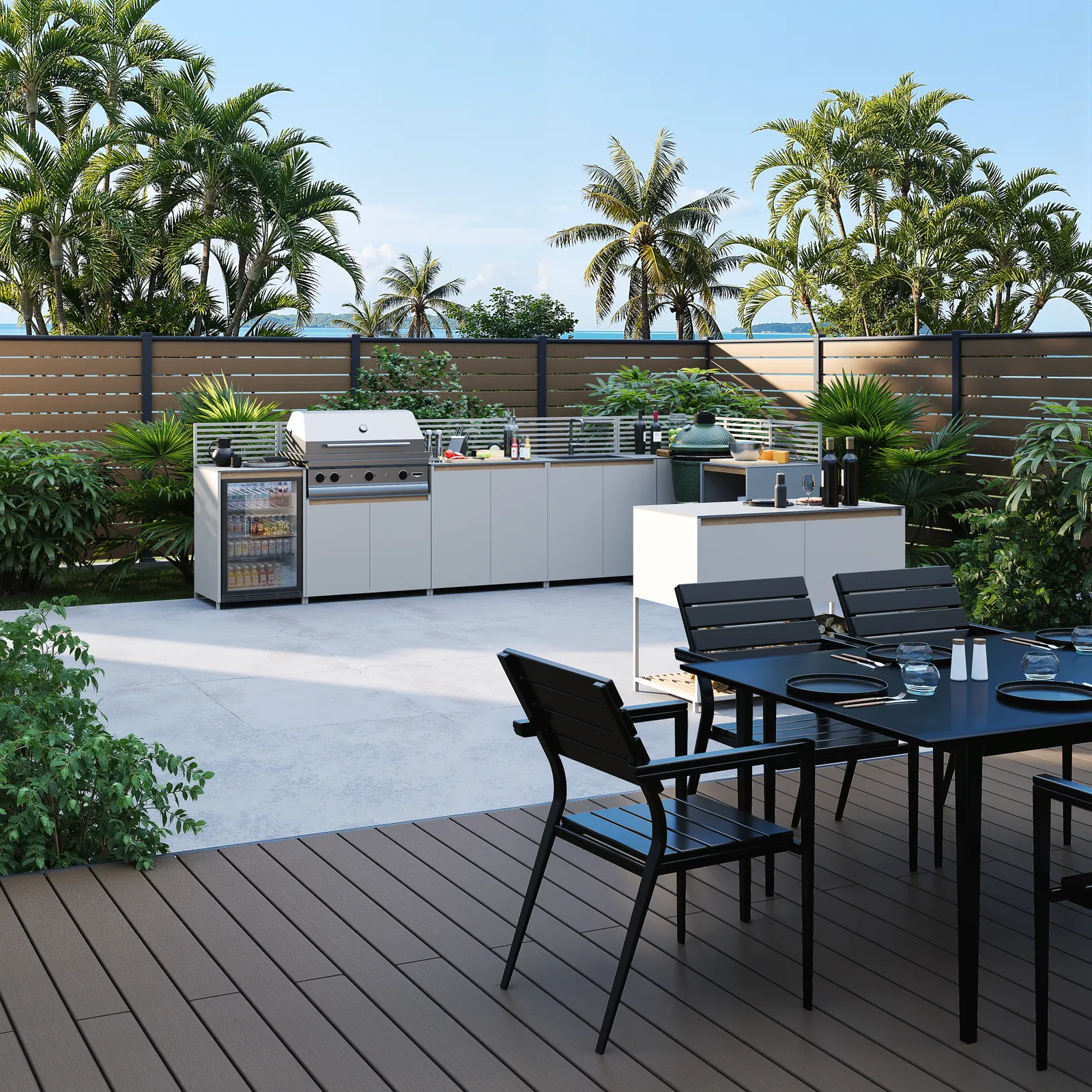 URBAN Modular Outdoor Kitchen on a Poolside Patio
The worktop edge and open shelf details show different surfaces that an artwork or finish request may touch. Mark which surface the logo or finish change concerns and whether the adjoining parts keep the existing finish. If the request affects the angled grip, include the affected door and its neighbor in the review. Check the grip and the door movement on the agreed revision before reusing the baseline front-panel specification.
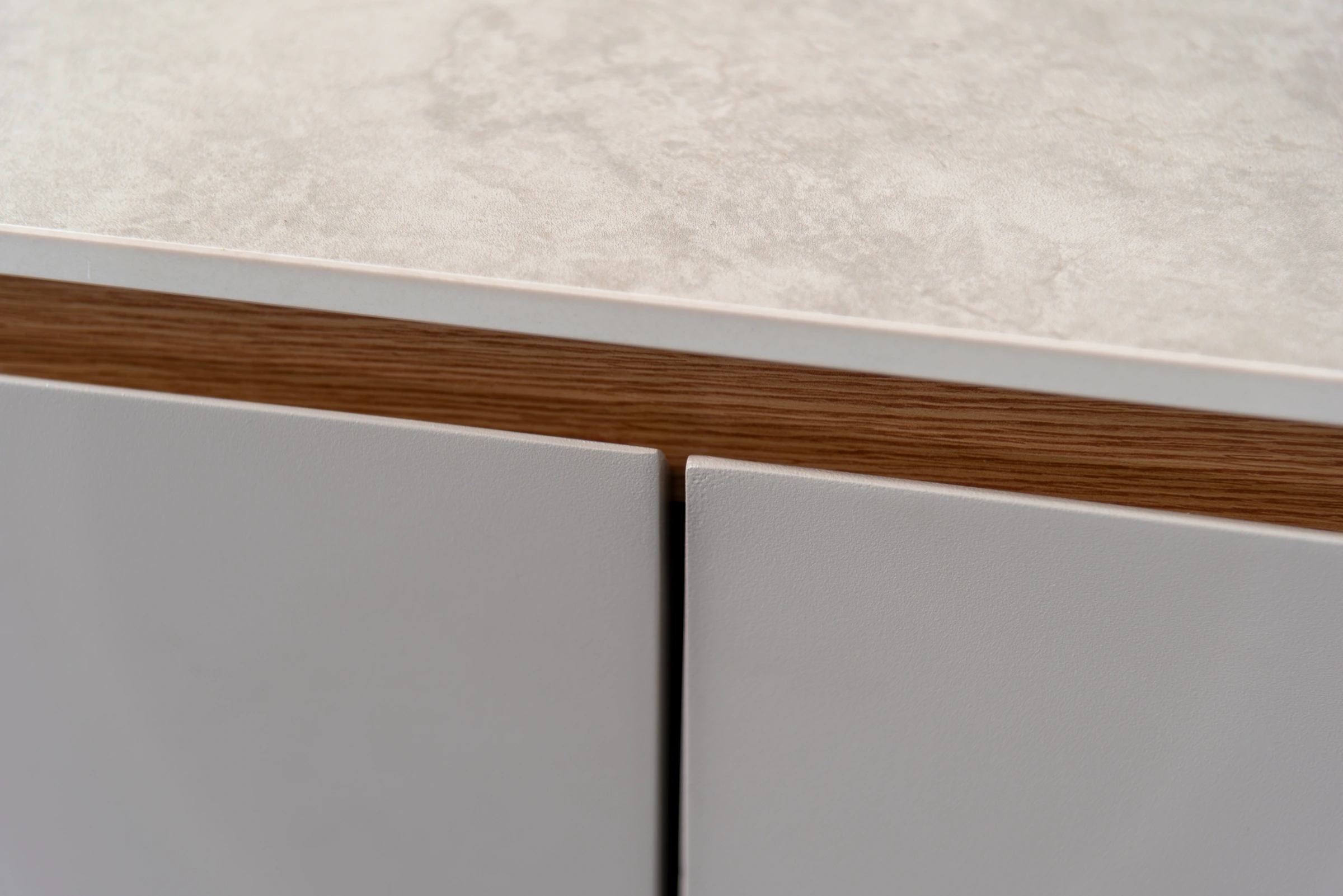 URBAN Sintered Stone Worktop Edge
 URBAN Aluminum Shelf with Wood-Grain Finish
Use the faucet detail to mark where the existing sink assembly meets the worktop. A proposal to move that position or introduce a different appliance opening needs a drawing and a fit review for the exact sink or appliance. Include any required hardware and worktop cutout information in the review request. The close-up provides a visual reference for locating the question. The approved product and fitting drawings establish the dimensions.
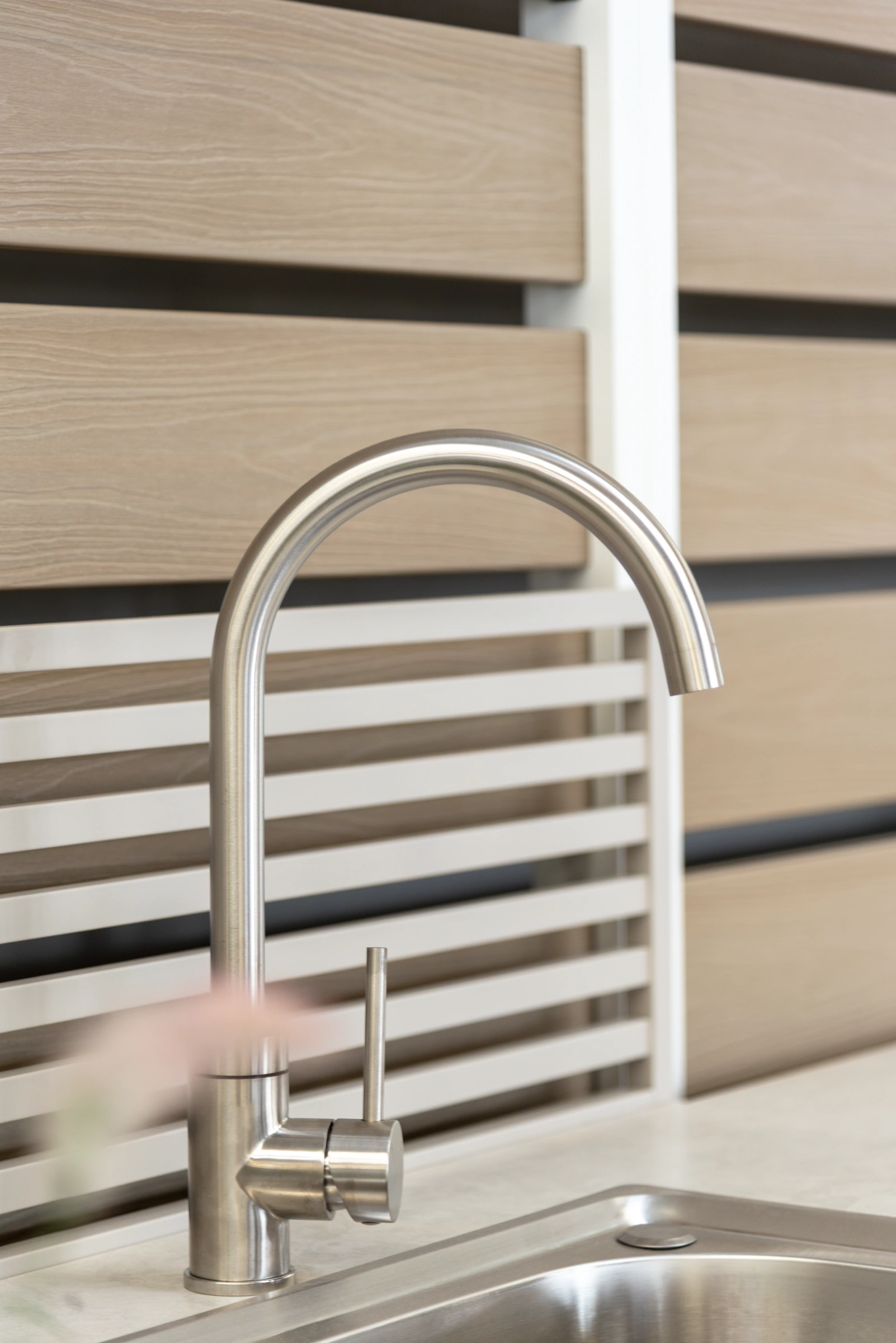 URBAN Metal Faucet
Compare the Review Scope Across Two Arrangements
On the simpler arrangement, mark the exact module affected and check the adjacent edges and hardware before extending the change elsewhere. An artwork change on one face can be reviewed against that face, finish and label register. A proposed worktop cutout needs a separate review of fit and applicable interfaces for the revised module, alongside anything the new position affects immediately around it.
- Refrigeration module
- Sink cabinet
- Prep and storage cabinet
- Lowered kamado module
For changes to one cabinet or appliance, record the affected module and the two connections or end conditions beside it.
Designed and created by the Outdoor Creation team.
For the more complex arrangement, check where the change touches another part of the layout, where the worktop or cabinetry is specified by segment, and how the full order is identified in packing and service. Ask the buyer, supplier and receiving team to work from the same marked drawing. A revision made to a single module can also need updated drawings or carton information for adjacent modules if their fit, grouping or identification changes.
- Refrigeration module
- Barbecue module
- Prep and storage cabinet
- Sink cabinet
- Open shelf at the turn
- Lowered kamado module
- Open shelf at the end
- Separate preparation island
Identify the long run, return and island separately when a request changes product interfaces, the packing list or the sales unit.
Designed and created by the Outdoor Creation team.
Choose a Different Reference Series When Needed
If the agreed material or cabinet design points to another baseline, use the corresponding product documentation to start the review. The current range includes AXIS galvanized steel cabinets with open mesh shelves, NOVA compact galvanized steel outdoor kitchen modules, METRO galvanized cabinets with a 304 stainless steel worktop and ELITE composite cabinetry with a sintered stone worktop. The modular outdoor kitchen systems and cabinet layouts page brings the series together. Start from the drawing for the series you actually choose, then apply the same change checks. You can also browse Outdoor Creation product ranges if the program has other outdoor living requirements.
Match Each Change to Evidence and an Approver
Route each request by its consequences. Send an artwork request for a visual proof and a check of identifiers if the primary brand changes. Add drawings and a sample check when the request affects a door, cutout or cabinet assembly. Ask the packaging reviewer to assess changes to protection, packing order or labels that govern where the cartons go. One request may need approvals on all three tracks. Wait for the last applicable decision before marking its overall status as approved for sampling.
When speaking with a modular outdoor kitchen manufacturer for brand programs, ask what can be confirmed from marked drawings, what needs a proof or physical sample, and what needs more information from the buyer. For example, request a cabinet fit check using the actual appliance model, with the critical interfaces marked before the factory prepares a sample. Keep the criteria with the sample record so a retailer, importer or quality team can reconstruct why it was accepted.
A buyer who asks for a branded badge near a new door grip has two immediate decisions. The brand owner can approve the artwork and viewing position. The product reviewer needs to confirm the proposed mounting surface, how the badge is attached and whether it affects grip access or door movement. If protecting the badge changes the pack, send that proposal to logistics as well. Record that the artwork can proceed to proof and list the evidence still required for product and packaging approval.
- Brand and channelWill the primary brand or sales label change?Reopen artwork and label review. Check identifiers with the sales channel where applicable.
- EngineeringWill fit, assembly or installation change?Reopen engineering review. Confirm the affected drawing and whether a sample must be checked.
- PackagingWill packing protection or handling change?Reopen packaging review. Agree on suitable verification for the planned route.
Apply every review that fits. Record why the baseline still applies to any item you leave unchanged.
Designed and created by the Outdoor Creation team.
Prepare the Development Brief for the Supplier
Send the Change List and Acceptance Criteria
Give outdoor kitchen suppliers a single file that identifies the reference configuration, proposed scope, intended markets, prototype quantities, planned order quantities, packaging and delivery conditions. For each requested change, include its reason, the current reference, the requested revision, the affected part or document and a named decision maker. Write a concrete approval test. For a label, use the agreed text, layout and file revision. For a cabinet assembly, name the drawings and the parts to check. For a pack change, name the original protection method and record how the proposed pack will be verified.
If someone introduces a new requirement after the sample brief is issued, compare it against the approved version and send it to the affected approvers. The NASA systems engineering guidance on configuration management describes documenting a baseline, reviewing proposed changes and verifying implementation. Apply that sequence at the scale of the purchase. A small label change may need a recorded proof. Keep a new cutout that affects fit open for engineering review until the drawing and verification criteria are agreed.
Agree the Review Sequence and Sample Release
Ask the supplier to respond to the requested scope in writing. Where an established configuration can be used, agree the exact model and interfaces. Where the request is custom, agree what the supplier can assess from your files and what requires additional design or sample work. For OEM or ODM development, identify who provides the artwork, product drawings and test inputs and who can approve each revision. Discuss small-volume needs with the supplier using the configuration, quantities and services required. Confirm what can be supplied and on what terms for the individual order.
When working with an outdoor kitchen factory on custom cabinets, ask how the proposed changes affect the selected module combinations before finalizing the development scope. See our outdoor kitchen production and assembly capabilities for the existing production context. Agree what will be ready before releasing a sample, who will receive it and how any failed check will be addressed. Put the decisions, including any revised figures or deferred options, in the sample request.
Agree the actual sign-off roles with the supplier and channel before review starts.
Designed and created by the Outdoor Creation team.
Record the Approved Production Reference
When the sample checks are complete, link the approved drawing, artwork and packaging revisions to the buyer's SKU and supplier configuration. Where you keep a retained sample, record its ID and who holds it. Send the relevant drawing, product and packing references to the factory, receiving team and service team so they can identify the physical order correctly. If a later order requests a different label, finish or layout, record the requested change against the approved reference and reopen the checks it affects.
1. Match the sample to the brief. Confirm the sample ID and the drawing, artwork and pack revisions it represents.
2. Inspect the affected changes. Check the worktop opening against the appliance drawing, verify the label proof or review packing protection, as applicable.
Did all applicable checks pass?
Yes · Record the approved sample
Link the sign-offs and sample ID to the approved revisions. Release the configuration that those approvals cover.
No · Hold and correct
Log the failed check, name the person responsible and record the corrected revision.
Return to step 1. Use the revised sample to recheck the affected changes.
Designed and created by the Outdoor Creation team.
Give each team the level of detail it needs. A store may need the surface finish, approved configuration and care information. The importer may need the same configuration linked to a label revision and carton grouping. Service needs enough revision information to identify the right replacement parts and any interfaces that changed. Keep these references together so a change that is visible on the kitchen can also be traced in the files used after delivery.
Private-Label Outdoor Kitchen FAQs
What should a private-label kitchen brief include?
Include the reference series, target market, proposed changes, responsible approvers and acceptance criteria. Record which drawings, samples and packaging files each approver needs.
Can I change the logo on an existing design?
Ask the supplier to confirm the placement, application method and approval process for your configuration. Supply artwork you have permission to use.
Does a primary brand change require a new GTIN?
Yes, under the GS1 GTIN Management Standard when the primary brand changes. Confirm the packaging levels affected and the identifier owner with your channel.
When does a cabinet change need a new sample?
Request a sample check when a change affects fit, function, assembly or visible finish. Agree which parts and acceptance criteria the sample must cover.
Can custom outdoor kitchen cabinets fit my grill?
It depends on the grill model and cabinet design. Ask your dealer to confirm the appliance specifications, required clearances and approved cabinet drawing before ordering.
Can I add an outdoor kitchen module later?
Ask the dealer to confirm which modules are supported for your series. Share your cabinet model and configuration so they can check dimensions and interfaces before you order.
When should revised packaging be reviewed?
Review packaging when protection, carton construction, packed weight or the distribution route changes. Involve your logistics team to decide whether additional verification is needed.
Who approves the kitchen before production?
Agree the approvers in the development brief. Brand, engineering and packaging teams sign off their applicable items, then buyer and supplier record the approved production reference.
Discuss Your Kitchen Development Brief
Send us your reference kitchen configuration, target market and proposed brand or cabinet changes. Our factory manufactures outdoor kitchen modules directly and can review the drawings, packaging requirements and sample checks your custom project needs before development.
Materials, hardware, installation and order terms depend on the approved project scope and confirmed final custom specifications.