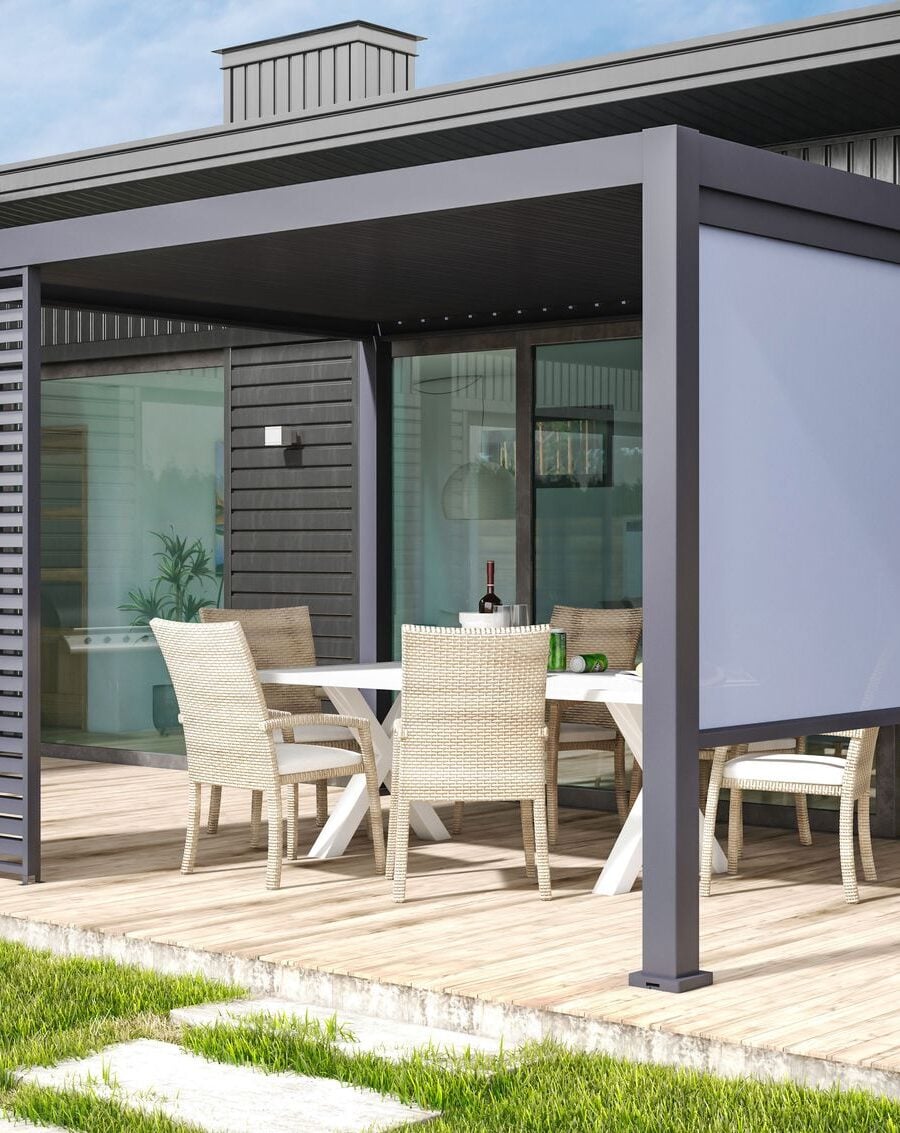
Wind, snow, and rain ratings for metal aluminum pergolas are often presented as simple catalogue numbers. For a professional commercial outdoor pergola buyer, however, the important question is not which outdoor structure supplier publishes the largest value. It is whether the stated performance evidence corresponds to the project location, pergola size, roof configuration, installation form, test method, and actual environmental requirement.
A wind-resistance class, a downward roof-load test, and a rain or water-management test measure different things. None of them should automatically be treated as a universal “all-weather” rating.
For distributors, importers, contractors, outdoor living brands and project companies, weather-performance evaluation should connect three separate layers: the environmental actions required at the installation site, the evidence available for the metal pergola product, and the final installed configuration including foundations, anchors, walls, accessories and drainage.
Direct answer: Aluminum pergola weather ratings should be assessed by matching the project's wind, snow and rainfall requirements with evidence for the exact pergola configuration being purchased. A factory test value is useful only when the tested model, dimensions, load direction, roof condition, test method and acceptance criteria are known. Local wind or snow design actions, rainfall intensity, foundations, anchoring and installation conditions must still be verified for the actual site.
What Does an Aluminum Pergola Weather Rating Actually Need to Prove?
A useful weather-performance statement needs context. Saying that an outdoor pergola is “wind resistant,” “snow rated,” or “waterproof” is not enough for an outdoor project decision.
The outdoor shade product buyer should separate three questions:
| Layer | Question | Typical Evidence | Main Risk |
|---|---|---|---|
| Site requirement | What environmental actions must the project be designed for? | Applicable building code, climatic data, local design criteria and structural calculations | Selecting a product before knowing the design conditions |
| Product evidence | What has the identified pergola actually been tested or assessed to withstand? | Third-party report, test appendix, calculation, product drawing and test configuration | Extending one sample result to unrelated sizes or configurations |
| Installed system | Can the complete pergola transfer the required actions safely at this site? | Foundation design, wall connection, anchors, drainage arrangement, installation drawings and local approval | Treating a laboratory result as approval of the complete installation |
In the United States, for example,
ASCE/SEI 7-22
covers environmental design actions including wind, snow and rain. The
ASCE Hazard Tool
provides location-specific hazard data used with ASCE standards.
That project data and a pergola manufacturer's test report perform different functions. One defines what the site may require; the other documents what a particular product configuration has demonstrated.
Why Wind, Snow and Rain Cannot Be Combined into One Pergola Rating
Wind, snow and rain affect an outdoor structure differently, so a single “weather resistant” number has limited engineering meaning.
| Weather Action | How It Acts on a Pergola | Important Variables | Evidence the Buyer Should Seek |
|---|---|---|---|
| Wind | Pressure, suction, uplift and lateral actions on the roof, frame and side components | Location, terrain, height, exposure, roof position, geometry, side enclosures and anchoring | Defined wind-performance test or engineering assessment for an identifiable configuration |
| Snow | Predominantly downward gravity loading, potentially affected by accumulation and drift | Regional snow conditions, roof geometry, exposure, adjacent structures, span and load distribution | Roof-load evidence plus project-specific determination of the required snow action |
| Rain | Water collection, drainage flow, possible ponding and wind-driven ingress | Rainfall intensity, duration, roof area, gutter and outlet capacity, roof level, wind direction and maintenance | Water-management test evidence, drainage design and site rainfall criteria |
The separate Outdoor Creation guide to
reading pergola load ratings
explains the differences between N/m², kN, kg/m², PSF and Beaufort. Those unit conversions are intentionally not repeated here. The purpose of this guide is to determine whether the evidence is relevant to the weather requirement of the actual project.
How Should a Buyer Read a Pergola Wind Rating?
A pergola wind rating should first identify the tested product and test condition. The number alone does not establish the allowable wind condition at every installation site.
Wind effects are influenced by factors outside the pergola factory. Geographic wind hazard, terrain and shielding, installation height, nearby buildings, topography, and structural importance may affect the design requirement. The final load path through beams, posts, wall brackets, base plates, anchors, and foundations must also be capable of transferring those actions.
For European projects, the European Commission Joint Research Centre identifies
EN 1991 Eurocode 1
as the family addressing actions on structures, including EN 1991-1-4 for wind actions. Applicable National Annexes and local requirements must still be confirmed for the destination country.
A product-performance test under EN 13561 is another type of evidence. Outdoor Creation's separate
EN 13561 louvered pergola guide
explains the standard, pressure classes, tested sample and report limitations in detail.
Buyer rule for wind claims
Do not convert a laboratory wind class directly into a statement such as “safe up to X km/h at any site” unless an appropriate engineering basis supports that conversion for the actual structure and installation. Ask for the standard, tested configuration, roof condition, pressure or load result, acceptance criteria, and installation assumptions.
What Does a Pergola Snow Load Claim Need to Show?
A downward roof-load test can provide useful structural evidence, but it should not automatically be renamed a snow-load rating.
Snow design begins with the project location and applicable code. The required roof action can depend on regional snow climate, roof shape, exposure, accumulation, drifting, and nearby structures. A pergola factory test using uniformly distributed mass does not reproduce every possible snow distribution.
Eurocode 1 identifies EN 1991-1-3 for snow loads. In the United States, ASCE 7 also establishes snow-load provisions and location-specific hazard data. Other jurisdictions use their own climatic data and design procedures.
For example, Outdoor Creation has previously used identified roof-load tests for specific NEO ALU and PRIME MAX pergola configurations. Those results are useful evidence for the tested products, but an 80 kg/m² or 120 kg/m² test should not be rewritten as a universal 80 kg/m² or 120 kg/m² snow rating without establishing that the test method, configuration, and project design requirement justify that statement.
The pergola buyer should request:
- Exact pergola model and tested dimensions
- Freestanding or wall-mounted configuration
- Roof position during the test
- Loaded roof area and loading arrangement
- Applied load and duration
- Measured deformation or other acceptance criterion
- Condition of the sample after unloading
- Relationship between the tested sample and the product being quoted
What Is a Meaningful Rain Rating for a Louvered Pergola?
Rain performance should be assessed as a water-management problem rather than reduced to a claim that the roof is simply “waterproof.”
When correctly closed, aligned and installed, a louvered roof can direct water through louver overlaps, surrounding gutters, transfer openings and drainage paths inside selected posts. However, actual performance can change with rainfall intensity, roof area, outlet capacity, installation level, debris, wind direction and the receiving site drainage.
For U.S. projects, NOAA's
Atlas 14 precipitation-frequency resources
provide rainfall-frequency information for selected durations and recurrence intervals. Such climatic information can help project professionals determine rainfall conditions; it is not itself a pergola product rating.
Likewise, a water test performed on a pergola does not prove that the occupied area will remain completely dry during every storm. Wind-driven rain can enter through open sides, and water that successfully reaches the bottom of a drainage post still needs an appropriate discharge route.
Outdoor Creation's
louvered pergola drainage-system guide
owns the detailed explanation of louvers, gutters, posts, outlets, and site discharge. The
weather-performance and regional-use guidance
provides additional operating and maintenance boundaries.
Why Does the Same Pergola Need Different Weather Review in Different Markets?
A pergola does not experience a different factory specification simply because it crosses a national border, but the project requirements used to judge that product can change substantially.
| Market Example | Reference Framework | Weather Information Relevant to Selection | Buyer Implication |
|---|---|---|---|
| United States | ASCE/SEI 7 and adopted building-code requirements | Location-specific wind, snow and rain parameters, plus site exposure and structural conditions | Obtain the applicable project design criteria before relying on catalogue ratings |
| European markets | Eurocodes, National Annexes and applicable product standards | Wind and snow actions vary by country, location and national parameters | Do not treat one European test document as a substitute for project-specific structural review |
| Canada | National Building Code of Canada 2025 and provincial or territorial adoption | Climatic design information, snow, rain and wind conditions vary significantly by location | Project city and province should be established before the structural specification is finalized |
| Australia | National Construction Code structural provisions | Wind-region and snow-action requirements are linked to referenced Australian and New Zealand standards | Cyclonic and non-cyclonic locations should not be treated as equivalent procurement conditions |
These examples are not a substitute for the locally adopted code. They demonstrate why the project address is a technical input rather than merely a shipping detail.
Canadian pergola and outdoor structure buyers can also review the separate
aluminum pergola sourcing guide for Canada
,
which addresses market-specific sourcing and project information without making its regional content the responsibility of this article.
How Should B2B Buyers Compare Weather Claims from Different Pergola Manufacturers and Suppliers?
The most useful comparison is an evidence-normalization exercise. Suppliers often present technically different values in the same quotation table, which can make one product appear stronger simply because its number is larger.
Before comparing the values themselves, normalize the context:
| Check | Acceptable Evidence | Warning Sign |
|---|---|---|
| Model | Exact model or clearly defined product family | Generic “our pergola” statement |
| Dimensions | Tested width, projection, height or loaded area identified | No sample size shown |
| Configuration | Freestanding/wall-mounted, roof zones, operating system and roof condition specified | One report used for every configuration |
| Method | Standard or documented test procedure stated | Only a photograph of weights or a water hose |
| Result | Applied condition plus measurable acceptance result | “Passed” without criteria |
| Scope | Written explanation of what the evidence does and does not cover | One test presented as proof for every size and climate |
| Current product match | Drawing or specification shows how the quoted product relates to the tested sample | Same product name assumed to mean identical construction |
This process is particularly important when sourcing private-label or custom pergolas from OEM/ODM manufacturers. Increasing span, changing beam or post profiles, moving posts, adding roof zones or converting between wall-mounted and freestanding arrangements can change structural behaviour.
The
aluminum pergola quality-control checklist
explains how approved drawings, specifications and production inspection should remain linked after the weather-performance basis has been selected.
Do Screens, Glass Walls and Other Pergola Accessories Change Weather Performance?
They can. Side components should not automatically be treated as visually independent accessories.
A wind screen, fixed privacy panel or glass enclosure changes the area exposed to wind and can change how pressure is transferred into beams, posts, tracks and foundations. Additional components may also affect drainage routes, maintenance access and the configuration covered by existing test documentation.
The influence depends on the accessory, opening position, geometry and supporting system. It should therefore be assessed rather than assumed.
For projects using wind screens, glass doors, side panels, heaters or lighting, verify whether the weather-performance evidence applies to:
- The pergola frame only
- The pergola with the accessory installed
- A defined open or closed accessory position
- A specific combination of roof and side-enclosure positions
Outdoor Creation's
pergola accessories collection
shows the range of screens, panels, glass systems, vertical or horizontal slats and other components that may need to be coordinated with the main pergola specification.
What Information Should Be Included in a Weather-Performance RFQ?
A pergola supplier cannot reliably recommend a weather-performance specification from outside dimensions alone.
Before requesting a final technical quotation, a professional buyer should provide:
- Exact project location: country, state/province/region and city.
- Installation environment: residential patio, hospitality terrace, rooftop, exposed coastal site or another application.
- Pergola dimensions: width, projection, height, number of bays and roof zones.
- Installation form: freestanding, wall-mounted or another project-specific arrangement.
- Known design criteria: project wind, snow, rain or other environmental requirements where available.
- Foundation and wall information: slab, footing, structural wall, rooftop support or other substrate.
- Accessories: screens, glass doors, fixed panels, lighting, heaters and fans.
- Required evidence: test reports, calculations, drawings, declarations or project-specific documentation.
- Responsible parties: identify who will provide local engineering, foundation design, permitting and installation approval.
The
pergola installation and site-requirement guidance
provides additional information on foundations, walls, rooftops and site preparation.
How Should Outdoor Creation Test Evidence Be Used?
Outdoor Creation develops and manufactures
manual and motorized aluminum louvered pergola systems
for global distributors, dealers, contractors, outdoor living brands and project buyers.
Available test evidence should be read according to its documented scope. For example, identified Outdoor Creation records include EN 13561 wind-resistance testing for a defined INTRO PLUS sample, water-pocket resistance information within the same report, and separate downward roof-load tests for specified NEO ALU and PRIME MAX configurations.
Those results should remain separated:
- The EN 13561 wind result is evidence for the identified test arrangement, not universal approval for every geographic wind condition.
- The recorded water-pocket result is not equivalent to a statement that every installed pergola is completely waterproof in every storm.
- The downward roof-load tests should not automatically be renamed universal snow ratings.
This distinction is intentional. Responsible weather-performance documentation should communicate both the result and its boundary.
Information about component preparation, assembly, inspection, testing coordination, and export production is available on the
Outdoor Creation aluminum pergola and outdoor structure manufacturing facility
page.
The Practical Rule for Selecting an Aluminum Pergola by Weather Performance
Do not start by asking which pergola has the highest wind, snow, or rain number. Start by determining what the project requires.
Then confirm five points:
- What wind, snow, and rainfall conditions apply at the project location?
- Which exact pergola configuration is being purchased?
- What test, calculation, or assessment supports each performance claim?
- Does that evidence correspond closely enough to the quoted product?
- Who is responsible for foundations, anchoring, drainage and final local approval?
For an international B2B buyer, the strongest specification is not necessarily the one carrying the largest catalogue value. It is the one where the project requirement, product evidence, approved configuration and installation responsibility can be traced to each other before production begins.
Review the Weather Requirements for Your Outdoor Pergola Project
Share the project location, pergola dimensions, installation form, known wind or snow design requirements, rainfall conditions, accessories and required technical documents. Outdoor Creation can coordinate relevant product specifications, available test evidence and manufacturing information for project review.
Technical note: Weather-performance information in this article is intended for product evaluation and procurement planning. Test values apply only to the samples, configurations, methods and conditions identified in the relevant documents. Wind, snow, rain, foundations, anchoring, drainage, structural connections, local building requirements and installation approval must be verified for the actual project. A roof-load test should not automatically be interpreted as a universal snow rating, and a water test should not be interpreted as proof of leak-free performance under every weather condition.