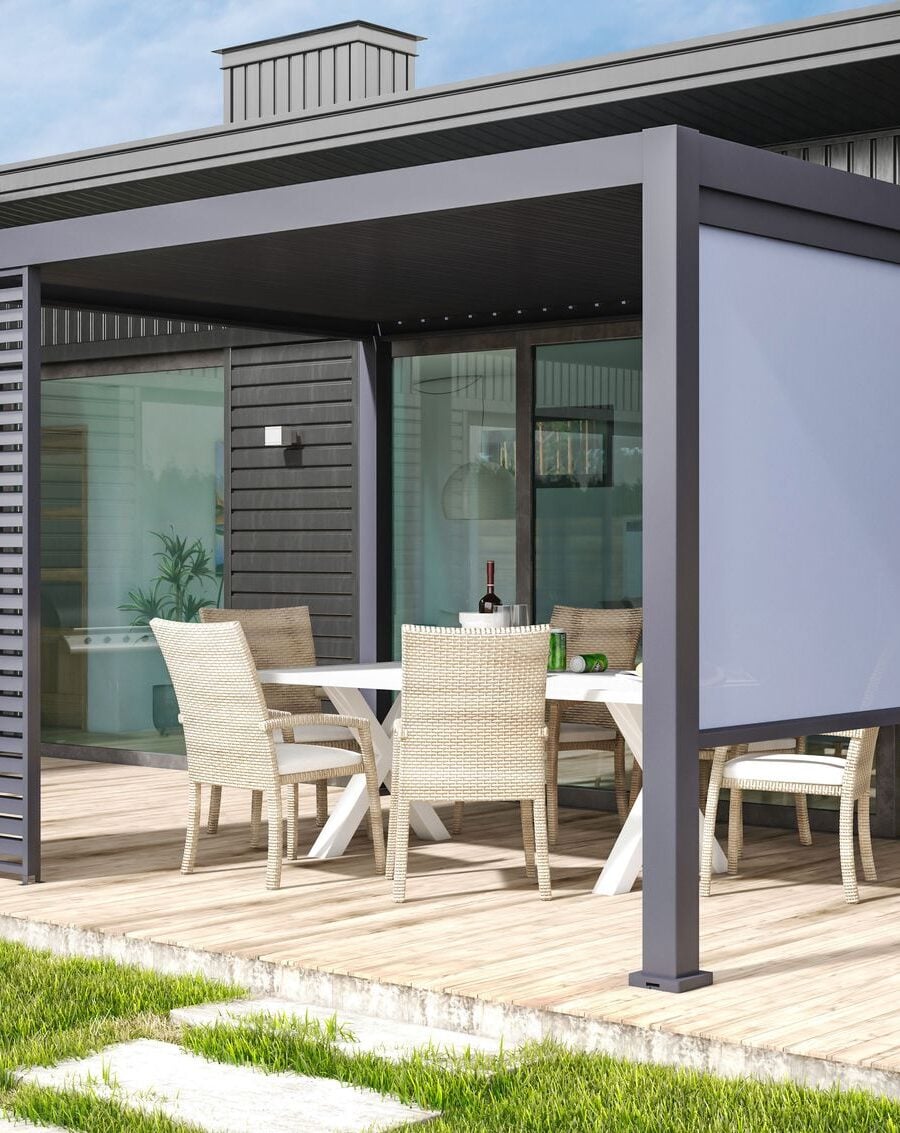
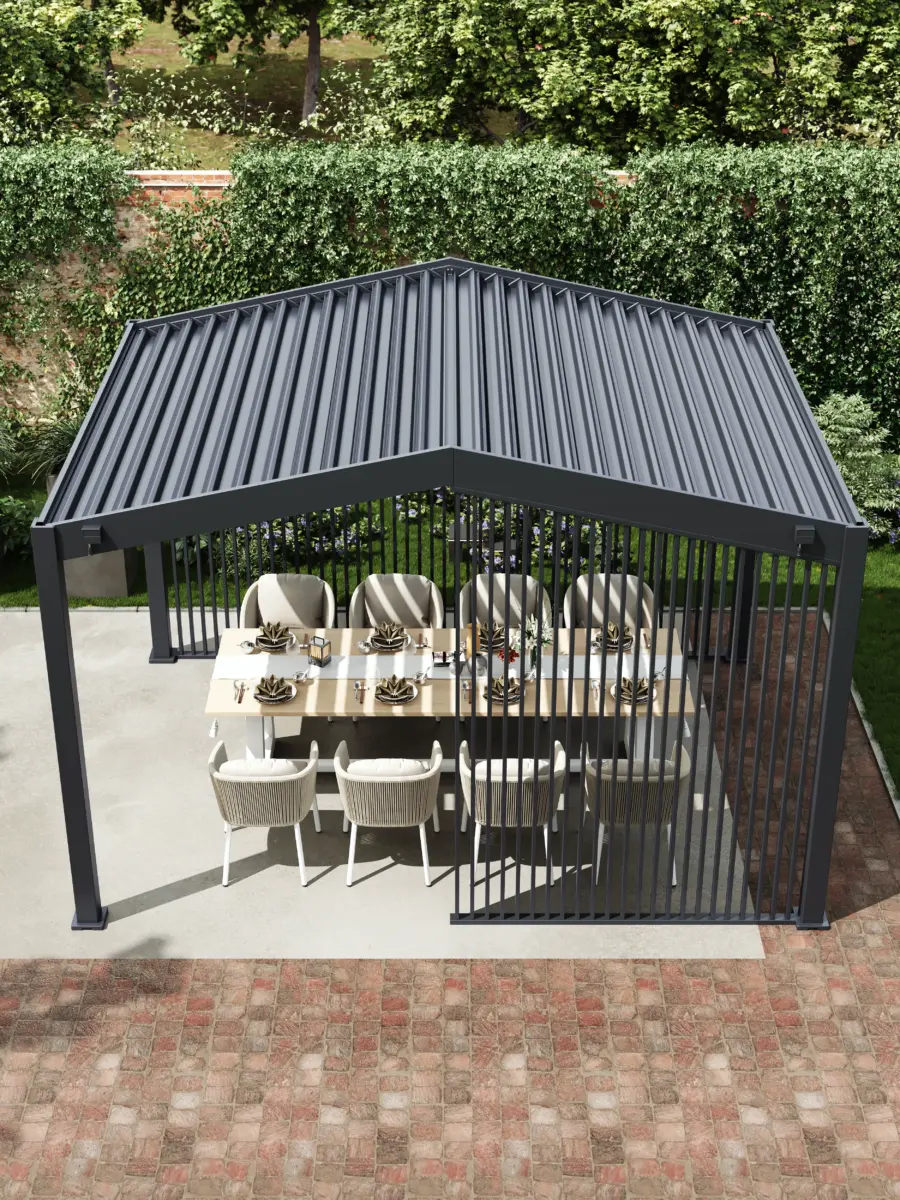
A wholesale aluminum pergola quote is determined by more than the outside dimensions of the structure. The quoted scope can include the aluminum profile system, roof configuration, operating mechanism, structural requirements, powder-coated finish, accessories, OEM or ODM development, packaging, order quantity, delivery term, documentation and destination-market responsibilities.
Two pergola supplier quotations may show the same nominal size and still represent materially different products. One may cover a standard manual roof supplied in factory packaging. Another may include reinforced profiles, multiple motorized roof zones, ZIP screens, custom branding, project drawings, export packing and freight to a named destination.
For an importer, distributor, outdoor living brand, contractor or project company, the practical question is therefore not simply:
“Which aluminum pergola supplier offers the lowest unit price?”
The more useful question is:
“Are the manufacturers quoting the same product configuration, commercial scope, delivery responsibility and evidence package?”
Direct answer: A wholesale aluminum pergola quote is normally affected by product size, profile weight, structural configuration, manual or motorized operation, roof zones, finish, accessories, customization, order quantity, packaging, logistics terms, and destination-market requirements. An accurate comparison requires each supplier to quote the same drawings, options, quantities, Incoterm, named place, documentation scope and quotation validity period.
A Pergola Quote Is a Scope Document, Not Only a Price
A professional quotation should define what the manufacturer, supplier or trading company has agreed to supply. The numerical price becomes meaningful only when it is linked to an identifiable product and commercial scope.
At minimum, a comparable aluminum pergola quotation should state the model or product platform, dimensions, installation form, roof type, operation system, color, accessories, quantity, packing method, trade term, named delivery point, currency, lead time and quotation validity.
Where the product is custom, the quotation should also clarify whether design review, CAD drawings, structural information, sample development, tooling, packaging artwork or testing is included.
| Quotation Area | Information That Should Be Defined | Risk If It Is Missing |
|---|---|---|
| Product identity | Series, model, drawing revision or approved configuration | The buyer cannot confirm which system the price represents |
| Dimensions | Overall width, projection, height, roof zones and post layout | Nominal size may hide a different clear opening or support layout |
| Included components | Frame, louvers, motors, controls, fasteners, drainage and accessories | Essential components may appear later as additional charges |
| Finish | Color, texture, gloss, coating specification and approved sample | Two visually similar finishes may have different process requirements |
| Commercial basis | Quantity, currency, Incoterm, named place and validity | Prices cannot be compared on an equivalent basis |
| Documentation | Drawings, manuals, packing list, reports and market documents | The quoted product may not be ready for approval, import or installation |
1. Product Platform and Roof Configuration
The first cost decision is the product platform. A standard manual aluminum pergola does not contain the same structure, components, or production scope as a large motorized louvered pergola with multiple roof zones.
Important configuration variables include:
- Manual or motorized louver operation
- Freestanding or wall-mounted installation
- Single-zone, double-zone or multi-bay roof layout
- Standard residential or reinforced project configuration
- Number and location of posts
- Drainage direction and designated drainage posts
- Compatibility with screens, glass, lighting or storage modules
A buyer should not request only a “3 × 4 m pergola price.” The manufacturer needs to know whether the dimensions refer to outside frame size, roof projection, post centreline or clear opening, and whether the structure is standard, wall-mounted, motorized or adapted to a particular project.
Outdoor Creation’s
aluminum louvered pergolas
shows why a metal outdoor shade structure product family can contain manual, motorized, standard, split-roof and heavy-duty configurations with different commercial bases.
2. Dimensions, Aluminum Weight and Structural Layout
Pergola dimensions affect more than the square metres of roof coverage. A larger shading structure may require longer or heavier beams, additional posts, more roof zones, extra motors, revised drainage, stronger connections and different packaging.
For example, a 3 × 4 m roof covers 12 m², while a 4 × 8 m roof covers 32 m²—approximately 2.67 times the plan area. The final quote should not be expected to increase by exactly 2.67 times. The larger system may require a different support layout, multiple roof sections, additional controls, and more complex transport packaging.
For aluminum profiles, a useful manufacturing calculation is:
Approximate profile-metal calculation
Total profile mass = Σ (finished profile length × verified profile weight per metre)
The verified kilograms-per-metre value is more useful than comparing only the outside dimensions of a post or beam. Two profiles with similar external dimensions may contain different internal chambers, wall sections, connection channels and functional details.
The Aluminum Association publishes alloy, temper, dimensional-tolerance and physical-property references through its
Aluminum Standards & Data
resources. The applicable alloy, temper and profile specification should be confirmed rather than inferred from appearance.
3. Aluminum Market Reference Is Only One Part of the Quote
Primary aluminum is an internationally traded material, and daily market references can affect extrusion and component costs. The
London Metal Exchange official prices
are widely used as global reference prices for physically delivered metals.
However, a finished pergola price cannot be calculated by multiplying the LME aluminum price by the finished product weight. An outdoor metal structure manufacturer’s material cost can also include billet or regional premiums, alloying, extrusion conversion, dies, heat treatment, ageing, process loss, surface treatment, machining and purchased components.
A useful quotation should therefore state its validity period and, for larger or longer-term programs, explain whether the price is fixed for a defined period or subject to an agreed material-price review.
Important distinction: LME is a metal-market reference, not a complete aluminum pergola factory price. It does not include extrusion conversion, coating, fabrication, motors, accessories, packaging, documentation, freight, duties or the supplier’s commercial responsibility.
4. Surface Finish, Colour and Exposure Conditions
Powder coating affects both product appearance and production planning. A standard colour produced in a regular batch may have a different quotation basis from a low-volume custom colour, textured finish, special gloss level or project-specific coating requirement.
The quotation should identify:
- Colour reference and approved physical sample
- Smooth, matt, textured or other surface appearance
- Required pretreatment and coating specification
- Visible-surface acceptance requirements
- Whether profiles and accessories require colour matching
- Coastal, humid, high-UV or other exposure considerations
The
QUALICOAT Specifications
define requirements relating to coating plants, materials and finished architectural aluminum products. Referring to a coating specification does not mean that a factory or product is QUALICOAT licensed unless the relevant licence and scope can be verified.
The finish should therefore be described in the quotation rather than reduced to the phrase “outdoor powder coating.”
5. Motors, Controls and Accessories
A motorized aluminum pergola quote should identify more than the word “motor.” The motor model, voltage, frequency, controller, number of roof zones and selected operating functions can change the component cost and the technical documentation required for the destination market.
Optional components can represent a substantial change in scope:
- Motorized or manual ZIP screens
- Beam-integrated or louver-integrated LED lighting
- Rain, wind or other control sensors
- Remote controls, wall switches or smart-control modules
- Glass sliding systems or aluminum privacy panels
- Heaters, fans and electrical preparation
- Spare motors, controllers and replacement components
Accessories should be quoted with their quantity, dimensions and interfaces. A screen price without the finished opening dimensions, motor specification, fabric selection and control arrangement is not a complete comparison.
6. Standard Supply, Private Label, OEM and ODM Are Different Quote Levels
The word “custom” can describe several different commercial scopes. Changing a colour is not the same as modifying a structural platform, and adapting an existing product is not the same as developing a new ODM system.
| Cooperation Level | Typical Scope | Possible Additional Quote Items | Main Buyer Approval |
|---|---|---|---|
| Standard supply | Existing model, standard size, finish and packaging | Limited configuration or accessory changes | Order configuration and commercial terms |
| Private label | Existing product supplied under the buyer’s brand | Logo, carton artwork, labels, manuals and photography | Branding and documentation approval |
| OEM adaptation | Existing platform with revised size, component or feature | Engineering review, drawings, samples, tooling or testing | Approved drawings, BOM, sample and specification |
| ODM development | New product concept or substantially new system | Concept development, engineering, prototypes, tooling and validation | Stage-gate approvals and production release |
Buyers planning an adapted or new system should review the
custom aluminum pergola OEM and ODM development process
.
That article explains how drawings, BOMs, samples, verification, packaging and production approval fit together. The present article focuses only on how those choices affect the quotation scope.
7. Order Quantity, Product Mix and Production Efficiency
Wholesale quantity affects the quote, but the relationship is not a universal discount percentage. A larger order can distribute some fixed preparation costs across more units, improve material planning and support more efficient production.
However, 30 identical pergolas are not operationally equivalent to 30 pergolas divided across ten sizes, five colours, several motor systems and different packaging labels.
The manufacturer should confirm:
- Quantity per model, size and colour
- Number of different configurations in the order
- Whether accessories are standardized or project-specific
- Whether production is one batch or several scheduled releases
- Whether packaging and labels differ by destination or sales channel
- Whether spare parts are included in the same production batch
A professional wholesale aluminum pergola company may therefore quote different unit prices for the same total quantity when the configuration mix is materially different.
8. Packaging and Container Utilization
Aluminum pergolas contain long profiles, coated surfaces, motors, controls, hardware, and installation components. Packaging must protect these parts while keeping each pergola identifiable and practical to unload, store and install.
Quote variables can include carton dimensions, protective film, foam, profile sleeves, corner protection, hardware boxes, palletization, crates, carton printing, barcode labels, installation sequence, and spare-parts packaging.
Packaging can also change freight efficiency. A product that uses more cartons, more empty internal volume, or non-stackable packages may occupy more container space even if its net product weight is similar.
The official
ISO 4180:2019 packaging standard
provides general rules for compiling performance-test schedules for complete filled transport packages. A reference to packaging testing should still identify the tested package, procedure and result.
Outdoor Creation’s
metal pergola manufacturing facility and export-preparation process
shows how component grouping, protective packing and container-loading preparation form part of the production workflow.
9. EXW, FOB, CIF and DAP Quotes Do Not Include the Same Costs
A factory price and a landed project cost are not the same commercial number. The delivery term and named place determine which transport activities and responsibilities are included in the supplier’s quotation.
The International Chamber of Commerce describes
Incoterms® 2020
as a global framework for allocating specified costs, risks and obligations between sellers and buyers.
| Quotation Basis | Typical Seller-Side Scope | Costs Commonly Remaining with Buyer | Comparison Requirement |
|---|---|---|---|
| EXW factory | Goods made available at the named factory or place | Collection, export handling, main transport, import and destination delivery | Confirm exact pickup point and export responsibility |
| FCA or FOB | Defined export-side delivery to carrier or vessel under the selected rule | Main freight or later transport, insurance where applicable, import and destination costs | Confirm rule, port or place, and container-loading scope |
| CIF or CIP | Seller-arranged carriage and required insurance to the named point under the rule | Import clearance, duties, destination charges and inland delivery unless agreed otherwise | Confirm destination, insurance basis and excluded local charges |
| DAP or DDP | Transport arranged to a named destination with different import responsibilities | Unloading and any responsibilities not allocated by the selected rule | Confirm exact address, access conditions, duties, taxes and unloading |
The named place is essential. “FOB China,” “CIF Europe” and “DAP customer warehouse” are incomplete descriptions without a specific port, terminal, address or agreed delivery point.
Freight should also be separated from the stable product specification. The
UN Trade and Development Review of Maritime Transport 2025
describes continuing uncertainty and freight-rate volatility in maritime transport. For this reason, freight validity may be shorter than product-price validity.
10. Customs Classification, Duties and Market Compliance
The factory quotation may not include every cost created by the destination market. Customs duties, taxes, local brokerage, port charges, product approval, engineering review and installation permits should be separated from the manufacturing price unless the quotation expressly includes them.
The
World Customs Organization Harmonized System
provides the international nomenclature framework used for customs classification. A complete pergola, a kit, loose aluminum profiles, and electrical accessories may require different classification analysis. The importer or appointed customs professional should confirm the applicable code and local tariff treatment.
EU-bound aluminum products may also require CBAM review. The European Commission confirms that the
EU Carbon Border Adjustment Mechanism
entered its definitive regime on 1 January 2026 and covers selected goods in sectors including aluminum.
CBAM should not be added as one generic percentage to every pergola quote. Its relevance depends on customs classification, imported quantities, embedded-emissions information and the legal responsibilities of the EU importer.
European aluminium pergola and outdoor structure buyers can review
CBAM planning for aluminum pergola imports
separately. That page owns the detailed CBAM topic; this quotation guide only identifies it as a possible landed-cost and documentation variable.
11. Technical Evidence and Documentation Can Change the Scope
A standard catalogue order and a project requiring test reports, revised drawings, installation documents, structural calculations or local professional review do not represent the same supplier workload.
The quotation should clarify whether it includes:
- General product drawings or project-specific drawings
- Profile sections and bill-of-material information
- Available third-party test reports
- Installation manuals and wiring information
- Product labels and destination-language documents
- Sample preparation or additional verification
- Engineer-reviewed or professionally stamped documents
Existing evidence should only be applied to the model, dimensions, and configuration that it actually covers. The article on
EN 13561 and louvered pergola performance evidence
explains why a standard number or test-report cover should not be treated as universal approval for every project.
How to Normalize Wholesale Pergola Quotations
Before selecting a metal shading structure supplier, place each quotation into one common comparison sheet. Do not compare the headline unit prices until missing and excluded items have been identified.
| Comparison Item | Quote A | Quote B | Normalization Action |
|---|---|---|---|
| Product size basis | Outside dimensions | Post-centre dimensions | Request one shared dimension definition |
| Roof operation | One motor included | Two roof zones and two motors | Compare the same roof-zone layout |
| Finish | Standard colour | Custom texture and gloss | Confirm one approved finish specification |
| Accessories | LED and screens excluded | LED and two screens included | Separate base pergola and option prices |
| Packaging | Factory cartons | Retail artwork and barcode labels | Add equivalent branding and packing scope |
| Delivery | EXW factory | CIF named port | Calculate both to the same delivery point |
| Documentation | Standard manual only | Drawings and report package included | Confirm the documentation actually required |
A lower unit price can have several explanations
It may reflect efficient engineering and production. It may also reflect a lighter configuration, excluded accessories, limited packaging, a different delivery term, or less technical support. The quotation alone does not identify which explanation is correct; the scope and supporting documents do.
Information Buyers Should Provide Before Requesting a Quote
The quality of a wholesale pergola quote depends partly on the quality of the inquiry. A vague request forces the supplier to make assumptions, which can later change the product, price, or lead time.
- Buyer type and sales channel: distributor, retailer, contractor, outdoor living brand or project company.
- Target market: country, region and intended residential or commercial application.
- Product platform: manual, motorized, freestanding, wall-mounted or multi-zone.
- Dimensions: width, projection, clear height, post positions and number of roof zones.
- Quantity: units per model, size, colour and planned delivery schedule.
- Finish: standard or custom colour, texture, gloss and exposure requirements.
- Accessories: motors, controls, blinds, screens, LEDs, glass, heaters, fans, hardware, and sensors.
- Customization level: standard, private label, OEM adaptation or ODM development.
- Technical requirements: wind, roof load, drainage, electrical, documentation, or local approval needs.
- Packaging: factory packing, retail artwork, labels, barcodes, spare parts or special handling.
- Delivery basis: requested Incoterm and exact named place.
- Timing: sample deadline, production target and required arrival date.
Outdoor Creation’s
B2B company and business-cooperation guidance
also identifies product type, size, installation method, project location, quantity and accessories as the basic inputs for a pergola quotation.
How a Manufacturer Should Present a Reliable and Professional Quote
A professional aluminum pergola manufacturer, supplier, company or brand should make the quotation understandable without requiring the buyer to reconstruct the product from messages, catalogues and separate attachments.
The quotation should be connected to:
- An identifiable model, drawing or configuration revision
- A clear list of included and excluded components
- Option prices separated from the base structure
- Quantity and configuration assumptions
- The exact Incoterm and named delivery place
- Currency, exchange rate, payment basis and quotation validity
- Production lead-time assumptions
- Packaging, documentation and inspection scope
- Items requiring buyer or local professional confirmation
This commercial clarity should form part of the wider process of
evaluating a louvered pergola manufacturer and supplier
.
The manufacturer-evaluation article assesses the company and its capabilities. This article assesses whether the quotation itself is complete and comparable.
Once the order scope is approved, the
aluminum pergola quality-control checklist
provides a separate framework for verifying whether production matches the quoted and approved specification.
The Practical Way to Compare Wholesale Pergola Prices
A wholesale aluminum pergola quote becomes useful when the buyer can answer five questions:
- Which exact product configuration is being quoted?
- Which components, services, and documents are included?
- Which assumptions affect the price and lead time?
- Where do the seller’s delivery responsibilities end?
- Which costs and approvals remain with the buyer?
The strongest quotation is not automatically the lowest or the most detailed document. It is the quotation that defines the product and responsibilities clearly enough for the buyer to compare alternatives, approve a specification and move into production without unresolved commercial assumptions.
For standard, private-label, OEM or ODM programs, price should be treated as the result of a defined product and supply scope—not as a substitute for one.
Prepare a Comparable Aluminum Pergola Quotation
Share the product platform, dimensions, quantity, target market, installation type, finish, accessories, customization scope, packaging requirements, and requested delivery term. Outdoor Creation can use this information to define a clearer product and commercial quotation basis.
Commercial note: The factors described in this article do not create a universal pricing formula. Material costs, freight, exchange rates, customs treatment, documentation requirements and product configurations can change over time and by destination. A final quotation should be based on the approved product scope, quantity, delivery term, named place and quotation validity stated by the supplier.