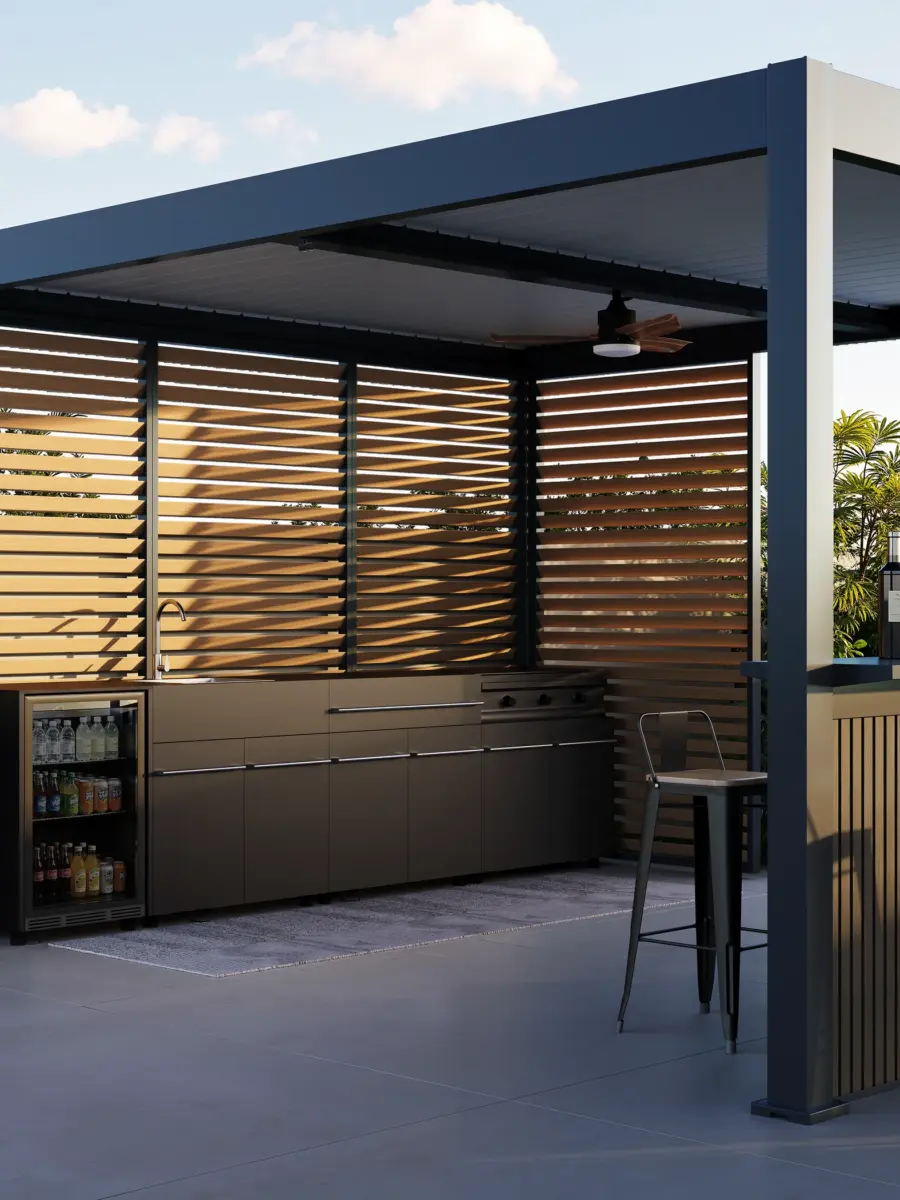
Compare outdoor kitchen quotations against one approved configuration and one delivery point before ranking prices. A cabinet package can omit the worktop, cutouts, an appliance or site work even when the drawings look similar. Match quantities and responsibilities line by line with the drawings and written confirmations. Keep required items open until each supplier’s scope and the buyer’s remaining costs can be assessed on the same basis.
Set One Basis for All Quotations
Freeze the drawing, revision and quantities
Start with the drawing approved for pricing, its revision, and the quantity of finished kitchens required. Use the same cabinet orientation, material, finish and equipment list for each offer. Record the worktop material, lengths, pieces and required openings where those details affect scope. Keep each supplier’s original units and product descriptions alongside the corresponding items on your approved drawing so a quantity conversion can be traced back to the original quotation.
A modular outdoor kitchen may appear as one set on one offer and several individually priced cabinets on another. Verify that both cover the same cabinet run, including pieces that appear only on a drawing or in a separate attachment. A total for a linear run and a sum of cabinet unit prices can be compared once their components, counts and worktop scope match. Look for differences between the main quotation, the layout and any product schedule. If one attachment shows a newer revision, ask the supplier which combination the quoted price covers.
For projects with multiple kitchens, identify which layout and finish apply to each location or phase. A large project total can conceal a missing unit or a mixed configuration. Keep the quantities by approved configuration and delivery location visible so different lot or shipment assumptions can be reconciled.
- Start with the quotations receivedRecord the supplier and the quote version.
- Fix one comparison basisAlign the required layout, quantities and named delivery point.
- Map differences and responsibilitiesClassify each difference and identify who owns it.
- Send the same clarificationAsk suppliers to confirm the applicable drawing and scope in writing.
- Close required itemsRepeat the clarification if any item is open. Ask for a revised quote where scope changes.
- Compare aligned totalsRank the cost of delivering the same confirmed scope.
Designed and created by the Outdoor Creation team.
Separate accepted scope from proposed alternatives
Write down the configuration every bidder is expected to price. A different cabinet material, revised run, substitute worktop or alternative appliance can be evaluated as a separate proposal. Give each alternative its own drawing or specification, record the change in function or responsibility and obtain approval before treating it as the new basis. If two layouts meet different needs, compare their functional and commercial implications before asking suppliers to price the selected layout.
Use the modular outdoor kitchen collection to identify the intended series and the comparison of modular, prefab and built-in procurement scopes if the competing offers represent different procurement paths. The New Zealand Government Procurement guidance on evaluation criteria illustrates why buyers set criteria and cost boundaries consistently before assessing offers.
Check What Each Kitchen Package Includes
Match cabinets, worktops and hardware
Ask what each offer covers when it lists outdoor kitchen cabinets as a package. Check the cabinet bodies, doors, shelves, handles and any panels required by the approved layout. Confirm the worktop material and finish, the pieces or spans being supplied, and who prepares the openings associated with the chosen equipment. Match any finish and hardware references to the approved samples or written specification and identify where those references appear in the offer.
The catalogue example for the NOVA galvanized steel modular outdoor kitchen identifies the A + B + E run. Use its distinct storage, sink cabinet and equipment base positions to trace the cabinet scope across the layout. Then confirm whether the supplier has priced the worktop, its preparation, the sink and the equipment separately or as part of that run. The product detail page shows the series and the drawing identifies the illustrated modules. The supplier’s written offer establishes which goods and tasks come with the order.
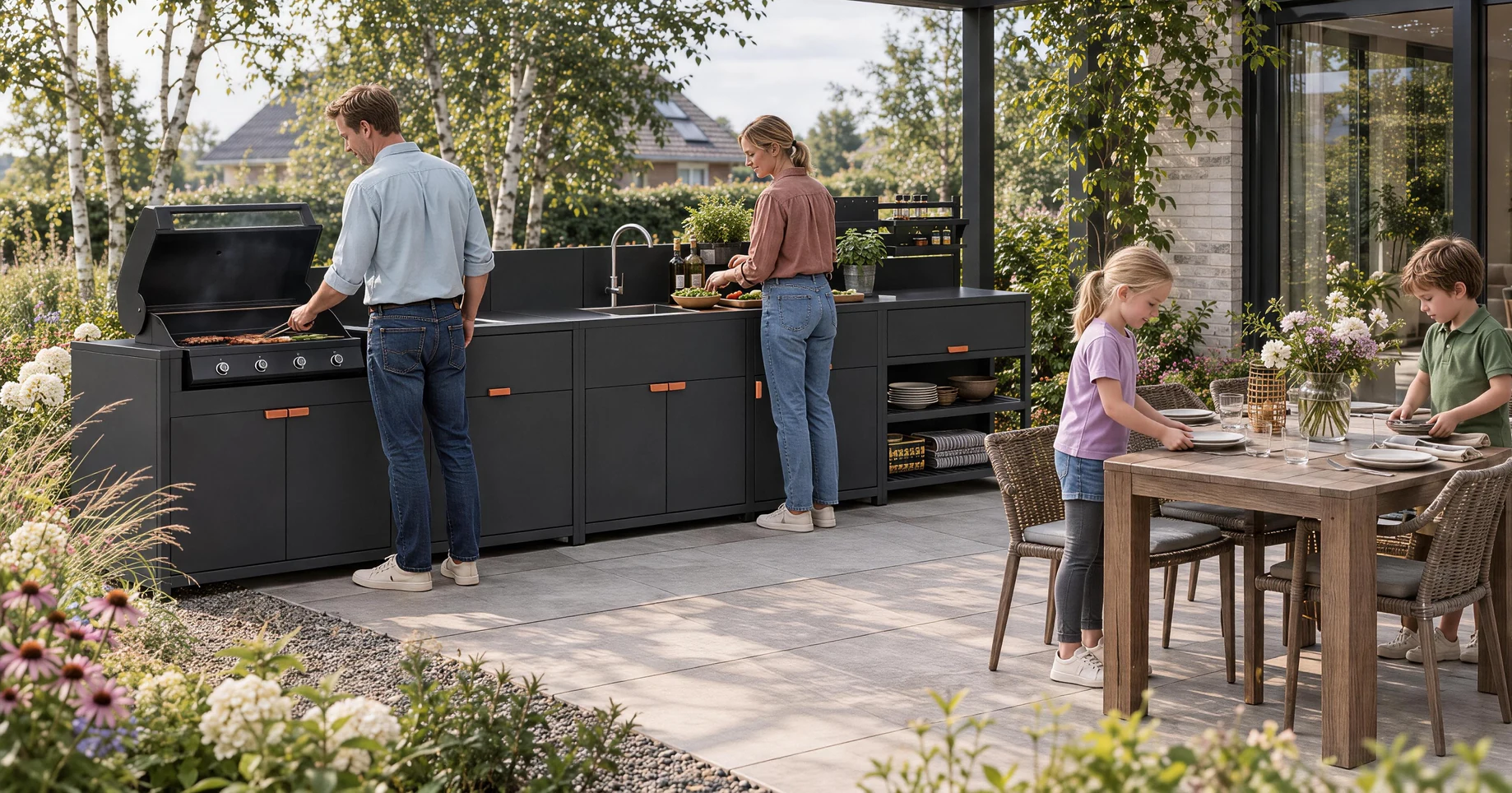 NOVA galvanized-steel outdoor kitchen in a garden cooking and dining scene
- A · Storage cabinet. Check which cabinet hardware and worktop sections are included.
- B · Sink cabinet. Confirm who supplies the sink and tap and who handles the connections.
- E · Appliance base. Confirm the appliance model, its installation interface and who supplies it.
Designed and created by the Outdoor Creation team.

Distinguish a component pictured on the product page from one selected for the order. For a handle or shelf, tie the picture to its written specification or item reference and check that the supplier has priced the right quantity and finish. For a worktop, tie the reference to the pieces shown on the layout and ask whether its surface finish and any required fabrication are covered in the same line.

Use the exact series when a quote describes a general feature. The AXIS outdoor kitchen with open shelving, METRO outdoor kitchen with a 304 stainless steel worktop and ELITE outdoor kitchen with composite cabinets and a sintered stone worktop give buyers separate references for those specifications. The Outdoor Creation product range helps trace other series names to their own product pages before a buyer accepts a substitution.
Trace appliance supply and the interface work
Record the exact appliance make and model and the party responsible for supplying it. Check who provides the manufacturer’s dimensional information, verifies the fit, prepares the opening and provides any specified support. Track who fits the appliance and who completes or tests the connections required at the location. A buyer-supplied appliance can still require preparation by the kitchen manufacturer, provided the parties specify and price that work with the correct equipment information.
- Equipment or fixture. Record the exact model and supplying party.
- Worktop and opening. Confirm the drawing revision and who cuts it.
- Cabinet and support. Check who supplies or modifies the support.
- Service connection. Assign the connection to the agreed party.
Designed and created by the Outdoor Creation team.
- Overall length. Define the start and end points, including any end pieces.
- Depth. Confirm whether the dimension follows the cabinet body or worktop edge.
- Module order. State the viewing direction, drawing revision and measurement unit.
Designed and created by the Outdoor Creation team.
With the URBAN modular aluminum outdoor kitchen with a sintered stone worktop, identify a separate prep table, back panel or faucet individually where selected. The standalone prep table and back panels have their own catalogue references. A buyer can use those references to ask which pieces are included and what worktop or site tasks accompany them. For a faucet, identify the supply, fitting and any final connection as separate responsibilities in the written scope.
 URBAN modular aluminum outdoor kitchen with a sintered stone worktop in a garden dining scene

Send the applicable appliance drawings and identify the current revision when requesting an updated scope. If the equipment changes later, check which cabinet opening, panel or support needs a revised drawing and whether the change affects price or timing. The guide to confirming grill, kamado and refrigerator integration explains the physical checks that inform this part of the comparison.


Compare a Manufacturer’s Offer With a Trading Company’s
Identify who owns production and who owns the contract
A manufacturer makes the products or carries out the production work within its factory scope. For that scope, the manufacturer can coordinate drawing changes, production approvals and inspection with the people doing the work. A trading company sources goods from one or more producers and coordinates the commercial order. It may offer a package spanning cabinets, appliances and logistics, with production carried out by the factories it engages. The U.S. International Trade Administration’s guide to export sales channels describes how an intermediary can coordinate commercial and shipping tasks. Either route can include agreed inspection, logistics and after-sales responsibilities. Confirm which legal entity is selling, which party performs each task and who is accountable for resolving a problem under the agreed terms.
Price differences can arise from what each business includes and how it presents those services. A factory quotation may price fabrication and factory packaging within a cabinet package and list separately sourced equipment or forwarding as options. A trading company may combine the factory’s charges with sourcing, inspection, consolidation, documentation and shipment coordination. Its fee may be a separate line or part of the unit price. A manufacturer’s unit price can also include its own margin and the cost of purchased components. Ask which services each offer covers, how they are priced and who provides them. A different seller model alone gives you little information about the cost of equivalent scope.
When evaluating an outdoor kitchen cabinet manufacturer for importers comparing modular packages, ask the supplier to document its production scope and identify goods or services it sources. At Outdoor Creation, we manufacture modular kitchens at our outdoor kitchen manufacturing facility in China. For any proposal, agree who provides inspection evidence, who approves a revised drawing, and who receives the claim if an item arrives damaged or differs from the agreed specification. The supplier evaluation guide for B2B kitchen buyers covers the checks used to assess capability alongside the quotation.
Compare B2B, OEM and ODM work in the scope
B2B outdoor kitchen supply can serve importers, distributors and project buyers operating on different specifications and handover arrangements. A distributor pricing a repeat range may need consistent finishes, repeatable labels and documents for its receiving team. A project buyer may need a coordinated drawing, a site-ready delivery sequence and a clear split of shop and site work. Ask each supplier for the documents and services the intended channel requires so both prices cover the same buyer task.
In an original equipment manufacturing (OEM) arrangement, the manufacturer produces to an agreed buyer specification. In an original design manufacturing (ODM) arrangement, the supplier develops some or all of the product design and manufactures the agreed product. The OECD’s manufacturing supply chain analysis describes these roles in terms of design and production. The offer and approval documents should establish who supplies the drawings, develops changes, approves samples and pays for any tooling or packaging development. Where custom work is proposed, obtain the applicable drawing, sample and production approval conditions in writing. Keep these costs and approval steps visible when comparing the two offers.
Put Shipping and Site Work on the Same Basis
Read the named delivery point and trade term
Use one destination and one defined handover point for your comparison. The top line of an offer can reflect handover at a named terminal or transport to an address where the kitchen will be received. Check the full named place, the delivery rule and its stated edition if the parties use one. Under the ICC’s Incoterms® 2020 rules, the selected rule allocates tasks, costs and risks connected with delivery. Read the named place with the rule and check which freight and handling services the seller priced.
Record the offer currency, price validity and what is due at each payment stage. When a buyer needs a common comparison currency, keep the exchange basis and its date next to the original figures. Put freight and insurance on the same basis, then verify any buyer-side customs charges, destination fees and onward transport relevant to the shipment. The U.S. International Trade Administration’s guidance on establishing a total export price lists factors such as transport, duties and other charges. Use written estimates for the actual shipment and destination.
Identify packaging, unloading and installation separately
Packaging is a supply item, transport is a delivery service and installation is site work. Ask what the factory is packing and how the shipment is broken down. Then check who provides unloading, moves the items into position, assembles the cabinets, fits the worktop and completes connections. Review those responsibilities with the supplier, freight provider and site contractor where their tasks meet. A delivery address by itself leaves several of those responsibilities open.
For example, a seller may price transport to a warehouse and assume the buying team will unload and arrange onward transport. Another may price delivery to the project location while leaving unloading to the site crew. Obtain an estimate for the remaining work using the package dimensions and receiving conditions, and match the delivery services and site tasks before comparing totals. If a buyer has yet to confirm access times or handling equipment, keep the cost of that required work open.
Resolve Options, Exclusions and Missing Information
Classify each exception before comparing totals
Use the supplier’s written offer and agreed drawings to assign one status to each required item. Mark it included when the offer explicitly covers the specified goods or work. Record a separately priced option as a distinct choice and ask for it to be incorporated into the base price if required. For buyer-supplied items, identify who will purchase or perform them and what written evidence establishes the remaining cost. Record an expressly excluded item as a gap until the relevant party and cost are confirmed. An item with ambiguous or missing information stays unconfirmed.
- Drawings and changes
- Factory-direct seller. Confirm who controls the production drawing and who signs off changes.
- Trading company. Name the factory and confirm who gives it the approved revision.
- Evidence to check. The approved drawing and a written change record.
- Quoted services
- Factory-direct seller. Confirm whether packaging, freight coordination and outside services are already included.
- Trading company. Check whether sourcing, consolidation and coordination are included or separately priced.
- Evidence to check. A written list of included services and excluded charges.
- Inspections and corrective work
- Factory-direct seller. Confirm inspection access and the factory contact for corrective work.
- Trading company. Ask who arranges factory access and who accepts and follows up on corrective work.
- Evidence to check. The agreed inspection point and named corrective-action contact.
Designed and created by the Outdoor Creation team.
Consider two cabinet packages on the same drawing. One confirms worktop cutouts for the selected sink and grill. The other supplies the worktop and assigns cutout work to the buyer. Use the kitchen and equipment drawings to confirm both openings and obtain the site fabricator’s written scope and cost where that work sits with the buyer. If the second supplier later offers to perform the work, obtain a revised quotation and retain the new division of responsibility. The buyer can then distinguish a real price difference from a difference in scope.
Ask each supplier the same clarification
Give each bidder the same current drawing, quantity and equipment references. Ask a question specific enough to resolve the line in dispute, such as who fabricates the specified opening and whether that work is included. Record the answer with its supporting document, revision and date. When an answer changes the amount, package or delivery obligation, ask for a revised offer so that the confirmation forms part of the commercial basis. The outdoor kitchen RFQ checklist for modular layouts and appliances identifies the supporting inputs to use if the supplier needs to reprice.
If you are coordinating with a factory direct outdoor kitchen supplier for importers reviewing delivery scope, identify the receiving point, what the local team handles and which delivery tasks need to appear on the revised offer. A buyer who operates a distribution warehouse can provide its receiving conditions. A project buyer can confirm the actual site handover with the contractor. Accurate conditions let the supplier determine what it can price and mark any portions that must remain conditional.
Decide Which Offers Are Ready to Compare
Compare the required scope after confirmation
Give each offer a clear outcome. It is comparable when the quote refers to the approved configuration and the buyer can verify the full cost of the required goods, tasks and handover. It needs clarification when a status, document or responsibility remains uncertain. A revised quotation is needed when a different configuration or commercial scope changes what the seller will supply. Keep a documented design alternative visible as its own decision throughout the review.
- ComparableRequired items, quantities and delivery assumptions match. Use the confirmed total for the common scope.
- Clarification neededA required item, cost or responsible party is open. Request written confirmation before ranking.
- Revised quotation neededThe drawing, offered scope or delivery basis differs. Request a revision on the common basis or evaluate the offer separately.
Designed and created by the Outdoor Creation team.
For comparable offers, combine the supplier’s confirmed price with verified buyer-side costs for required scope on the same basis. Count a task already included in the supplier package once. Compare discretionary choices on their own terms and keep the written price validity and payment obligations available to the commercial team. Mark which party will close any remaining approval condition and keep the dated evidence for each cost used in the decision.
Check revised scope before order release
Read the selected quotation with the drawings, appliance list, worktop specification, equipment interface notes and delivery responsibilities the parties are relying on. Check that the correct documents are referenced in the final commercial record and that each exclusion or permitted substitution is still understood. Ask both the buying and supplier teams to resolve any difference that appears after approval, including a finish change, substituted item or revised receiving point.
Record the accepted revision, approval date and agreed scope so the people coordinating production, delivery and site work use the same instructions. Where a custom detail still requires fit confirmation or sample approval, make the dependency and responsible party explicit before releasing the affected work. The order record should give each team a clear basis for confirming that the delivered kitchen matches the approved package.
Frequently Asked Questions
Can homeowners compare outdoor kitchen quotes by price alone?
Compare prices after matching the layout, worktop, equipment, delivery and installation. Ask each seller to confirm who supplies and fits every item needed for a working kitchen.
Does a cabinet quotation include the worktop?
It depends on the offer. Check the written inclusions for the specified worktop material, pieces and fabrication, including any required openings.
What should an outdoor kitchen quote include?
It should identify the selected configuration, item quantities, goods and services, exclusions, delivery conditions and site responsibilities. Use the current drawing and exact equipment list to verify coverage.
How do I compare quotes with different layouts?
Have both suppliers price the same approved layout and revision. Evaluate an alternative layout separately with its own scope, functions and conditions.
Can I compare quotes with different delivery terms?
Yes, once you verify the costs and responsibilities needed to reach the same handover point. Retain each quote’s named place and the trade rule edition where applicable.
How should I record items marked optional?
Record separately priced options individually. If the selected project requires one, ask the supplier to include it in the common quotation basis before comparing totals.
Who supplies installation and utility connections?
The written order and site scope identify who performs each task. Check the supplier’s and site contractor’s responsibilities for assembly, fitting and connections before placing the order.
What should match before I approve the order?
Match the quote and drawing revisions, cabinet and worktop scope, exact equipment and quantities, delivery terms, and the written allocation of site responsibilities.
Send your current cabinet drawing, equipment list and delivery point. As a B2B outdoor kitchen manufacturer producing in our own factory, we can review scope differences with your team, discuss custom requirements and identify the details needed for a comparable quotation.
Materials, hardware, installation responsibilities and order conditions depend on the selected configuration and site. Confirm custom requirements and final specifications in writing before ordering.